
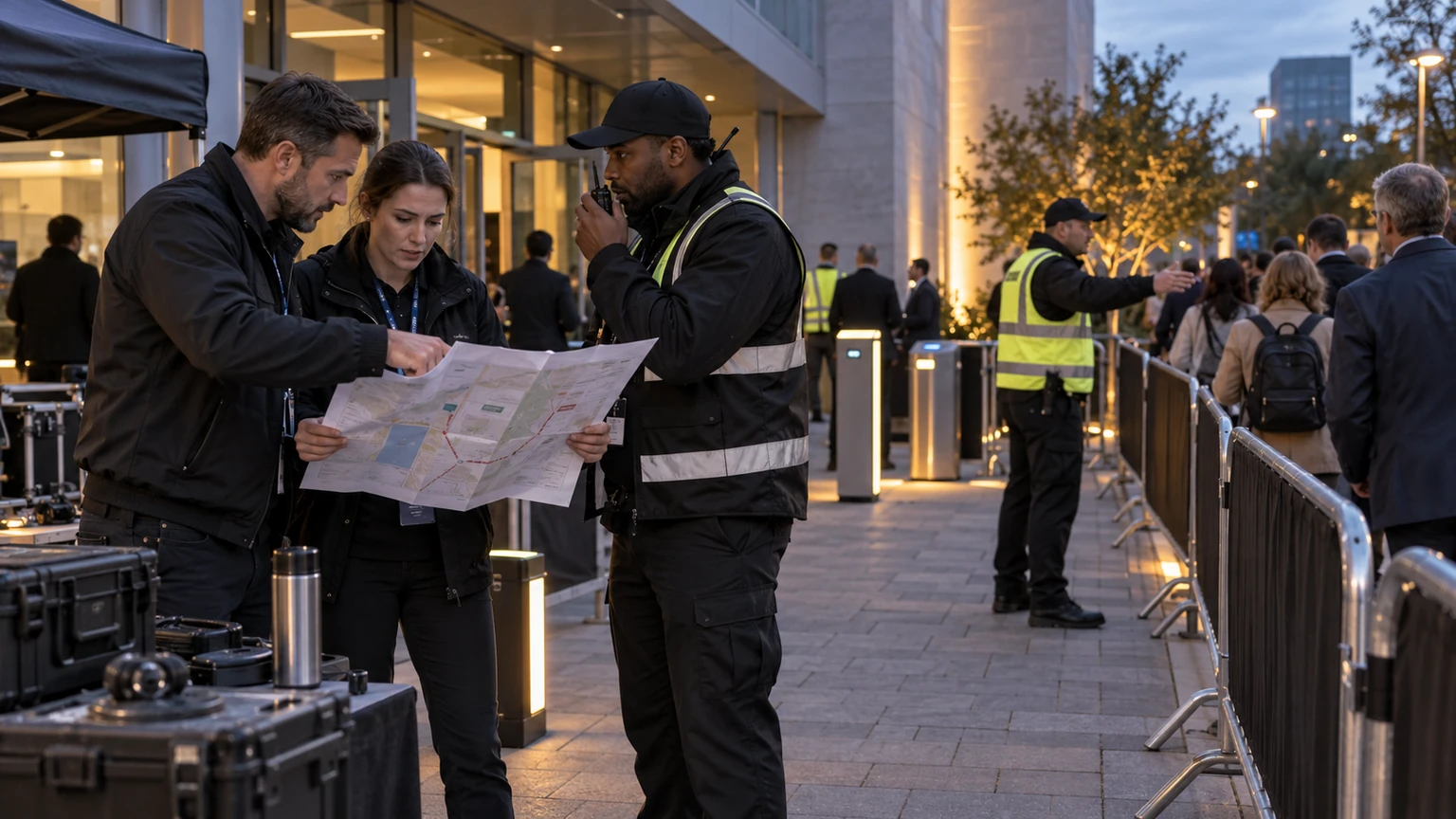
Protests near conferences, exhibitions, and large public events are not edge cases. For many organizers, they are a realistic operating scenario that should be planned for early, not treated as a last-minute security issue.
That matters because a protest can affect ingress, staffing, transport, exhibitor movement, VIP schedules, media handling, and attendee confidence, even when the protest itself is lawful and peaceful.
The source signal behind this topic is useful but limited. It points to growing attention on protests and sensitive crowds in event management, and it supports a practical discussion about how organizers should assess risk and prepare operationally.
What it does not give us on its own is a universal protest response standard, legal advice for every jurisdiction, or proof that one staffing or security model fits every event.
A protest should be planned for as an event condition, not outsourced as a surprise problem.
Why this matters for event operations
Too many teams separate protest planning from core event planning. In practice, that creates gaps.
If a protest affects your venue perimeter, your operational questions are immediate:
- can attendees still enter safely and clearly
- do staff know which route changes are approved
- who speaks to exhibitors, speakers, and venue partners
- what threshold triggers police liaison or escalation
- how will transport and loading be affected
- how will you distinguish lawful protest activity from a developing safety incident
These are event operations questions as much as security questions.
For organizers, the goal is not to suppress legitimate protest activity. The goal is to protect people, maintain lawful operations, and make calm decisions under pressure.
What the public signal tells us, and what it does not
From the source idea provided, the confirmed signal is straightforward: organizers increasingly need practical guidance for handling protests and sensitive crowds around events.
That is enough to support a grounded planning framework.
What this source does not confirm on its own is:
- the exact protest scenarios most likely at your event
- the legal powers available to venue security in your location
- the right staff-to-attendee ratio for every site
- whether a visible security posture will calm or inflame the situation
- how local authorities will respond on the day
- which communications approach will suit every audience
That distinction matters. Public discussion can highlight the issue. It does not replace local planning, legal review, and venue-specific rehearsal.
The safest response is usually the one that is most prepared, least improvised, and clearest to staff on the ground.
Start with a protest-specific risk assessment
Your standard event risk register may mention demonstrations in broad terms. That is not enough.
Create a protest-specific assessment that looks at three separate dimensions:
1. Intent
What is the likely purpose of the protest?
- awareness and visibility
- disruption of the event brand or sponsor presence
- direct action targeting a speaker, exhibitor, or issue
- counter-protest activity
Intent affects where the pressure will show up first: entrances, keynote spaces, exhibitor areas, media zones, or transport routes.
2. Capability
What level of turnout and coordination is realistic?
- small symbolic gathering
- organized march or rally
- coordinated entrance disruption
- online mobilization that shifts quickly on the day
Capability matters more than rhetoric. A noisy social media thread is not the same as a group with marshals, transport plans, and known gathering points.
3. Impact
What could realistically be affected?
- pedestrian access
- vehicle movements and loading docks
- queue safety
- delegate anxiety or confusion
- VIP or speaker movement
- session continuity
- reputational visibility
Separating intent, capability, and impact helps teams avoid overreacting to low-risk activity while still preparing for operational disruption.
A simple risk matrix event teams can use
Many teams overcomplicate this step. A simple matrix is usually enough if it is reviewed with the venue and security partners.
Low risk
Small, peaceful protest expected outside the venue footprint, limited effect on access, no known counter-protest.
Primary needs:
- monitoring and liaison
- clear staff briefing
- pre-approved attendee messaging if needed
Moderate risk
Likely protest near main ingress, moderate media interest, possible congestion, potential targeting of a speaker, sponsor, or exhibitor.
Primary needs:
- adjusted routing plans
- additional stewards at pressure points
- holding statements and internal escalation tree
- venue and authority coordination
High risk
Expected direct disruption, multiple access points affected, credible threat of crowd surge, hostile interactions, or counter-protest presence.
Primary needs:
- command structure activation
- segregated routes and controlled entry changes
- enhanced staffing and perimeter management
- formal liaison with police, venue leadership, and medical teams
- rapid decision points for delaying, pausing, or relocating operations
Keep the matrix practical. It should drive actions, not sit in a document folder.
Staffing: put people where decisions and pressure meet
When protests affect events, the first failure is often not numbers. It is placement.
Organizers should map staffing around friction points, not just around the published floorplan.
Priority staffing zones
- main public entrances
- secondary entrances and emergency access paths
- registration and badge pickup
- VIP and speaker arrival points
- loading docks and exhibitor access
- transport pickup areas
- media gathering points
Each zone should have a named lead, a radio or communications method, and a clear rule for escalation.
Key staffing roles to define in advance
- incident lead: owns the operational picture and major decisions
- venue liaison: coordinates with venue control room or duty manager
- security lead: manages contracted security deployment and response posture
- communications lead: approves attendee, exhibitor, and media messages
- floor supervisors: handle local decisions in assigned zones
- welfare lead: monitors attendee and staff wellbeing if delays or tension build
Not every event needs a large structure. Every event does need role clarity.
Routing: plan alternatives before you need them
Routing is where risk planning becomes visible to attendees.
If one entrance is blocked, slowed, or under pressure, teams need a pre-approved alternative that is realistic, staffed, signed, and communicated. A route is not a route if it exists only on a map in the control room.
What to prepare
- primary and secondary pedestrian ingress routes
- separate routes for exhibitors, staff, and VIPs where justified
- vehicle rerouting for contractors and production suppliers
- accessible routes that remain usable if crowd conditions change
- safe holding areas for queue management
- protected emergency access lanes
Walk these routes physically with the venue and key partners. Check pinch points, barriers, sightlines, lighting, and signage.
If an alternative route adds ten minutes of walking, that affects arrival curves, staffing needs, and session starts. Build that into the operating plan.
Communications: say less, but say it clearly
During a protest-related disruption, poor messaging creates secondary risk. People fill gaps with rumor, screenshots, and assumptions.
Your communications approach should separate audiences and keep messages factual.
Attendees
Tell them what they need to do next:
- which entrance to use
- whether they should delay arrival
- what transport point has changed
- where to find official updates
Avoid loaded language unless confirmed by authorities or your incident lead. Operational clarity matters more than dramatic detail.
Exhibitors and sponsors
They need different information:
- loading or access impacts
- booth staffing instructions
- changes to hospitality or invitee routing
- who to contact for immediate support
Speakers and VIPs
Keep communications direct and controlled. If a particular individual is a focal point for protest activity, minimize unnecessary movement and reduce ad hoc decision-making.
Staff and contractors
Internal teams need short operational updates, not long explanations.
A useful format is:
- what has changed
- what action to take
- who is approving exceptions
- when the next update will come
A practical response playbook
Teams work better with trigger-based playbooks than with vague instructions to stay alert.
Scenario 1: Peaceful protest near venue perimeter
- confirm size, location, and movement pattern
- maintain liaison with venue and local authorities if appropriate
- brief front-of-house teams on expected attendee questions
- monitor queue length and route congestion
- issue attendee guidance only if access is affected
Scenario 2: Entrance obstruction or queue disruption
- activate secondary ingress plan
- redeploy stewards to route attendees early, away from bottlenecks
- pause non-essential arrivals in restricted vehicle zones
- update attendees, exhibitors, and speakers with revised access instructions
- record timeline and decisions in the incident log
Scenario 3: Targeted disruption inside or at immediate entry point
- protect life safety first
- separate affected area from normal attendee flow
- escalate through command structure immediately
- coordinate with venue security and authorities
- decide whether to hold, pause, or relocate nearby programming
- issue controlled internal and external statements
Scenario 4: Counter-protest or rising hostility
- treat this as a changed risk level, not a continuation of the same scenario
- increase supervision at likely flashpoints
- prevent crossing flows where possible
- review egress and welfare arrangements
- reassess whether public arrivals should continue through the same route
Checklists for the week before the event
Operations checklist
- review protest-related scenarios with venue and security partners
- confirm command roles and contacts
- walk primary and fallback routes
- test radios and backup communications channels
- prepare barrier, signage, and queue equipment locations
- verify accessible routing alternatives
- confirm incident logging process
Communications checklist
- draft attendee holding statements
- draft exhibitor and sponsor alerts
- prepare internal staff briefing notes
- identify single approval owner for urgent messages
- align public-facing language with venue and legal guidance where needed
- monitor likely information channels before the event opens
Leadership checklist
- define thresholds for escalation
- agree decision rights for delaying entry or changing schedules
- review insurance, duty-of-care, and reporting obligations
- confirm who will liaise with police, venue leadership, and medical teams
- schedule a short pre-open risk review on event day
Where teams often get this wrong
They rely on generic security plans
A standard crowd management plan may not address protest-specific issues such as targeted entrances, media pressure, or values-sensitive attendee messaging.
They confuse lawful protest with automatic high threat
Overreaction can create avoidable tension. Teams need proportionate response, based on behavior and impact, not assumption.
They underprepare for route changes
If rerouting is not rehearsed, it often fails at the exact moment attendees need certainty.
They leave communications too late
Silence can be useful for a minor issue. Silence becomes harmful when access is visibly changing and attendees have no official direction.
They forget staff welfare
Front-line teams may face stress, confrontation, or confusion. Rotation, backup, and clear supervisor access matter.
What a balanced policy approach looks like
The most effective organizers avoid two extremes: treating protests as normal background noise, or treating every demonstration as a full crisis.
A balanced policy usually includes:
- respect for lawful activity outside the event's own operational footprint
- clear standards for protecting access, safety, and emergency movement
- defined escalation criteria based on behavior and disruption
- documented coordination with venues and public authorities
- auditable decisions and message approvals
This is not only about security. It is about governance and operational consistency.
Calm event operations depend on decisions made before the crowd arrives.
What this means for event teams
Protests should not sit at the edge of event planning. For many conferences, exhibitions, and public events, they belong inside the operating model.
The practical work is straightforward: assess likely scenarios, map real impacts, assign roles, prepare alternate routes, and write message templates before you need them.
Organizers do not need to predict every outcome. They do need a disciplined plan for the outcomes most likely to affect safety, access, and continuity.
That is the difference between reacting to a sensitive crowd issue and managing it professionally.