A speculative media idea is useful for event teams because it points to a very real operational question.
If TV networks borrowed more from trade shows, or if trade shows borrowed more from live broadcast thinking, the result would not just be more cameras on-site. It would be a different approach to programming, sponsorship packaging, and attendee engagement.
That matters for organizers because many trade shows already function like media environments. They have audiences, stages, segments, recurring personalities, sponsor inventory, and moments that can be turned into stories.
The interesting shift is not “trade shows on TV.” It is treating the event itself as a live content product without losing operational discipline.
This is still a hypothetical framing, not a confirmed industry transition. But it is a useful one. It helps organizers think more clearly about how live event content, floor activity, and sponsor value can connect.
Why this idea matters to trade show organizers
Traditional trade show planning often separates three things that attendees experience together:
- the exhibition floor
- the conference or stage program
- sponsor visibility and partner activations
When those parts are planned in silos, the event can feel busy but not cohesive.
Broadcast thinking pushes in the opposite direction. It forces teams to think in sequences: what the audience sees first, what deserves attention now, what should happen next, and where sponsor presence fits naturally.
For event operators, that can be valuable because it creates a stronger link between content planning and crowd movement.
Think in programming blocks, not only agenda slots
Most event agendas are lists. Broadcast schedules are usually built as flows.
That difference matters.
A trade show that wants stronger live storytelling can start by grouping its day into clear programming blocks, each with a purpose. For example:
- opening market overview
- buyer-focused product reveals
- live demos from the floor
- expert interviews
- end-of-day recap
This does not require a television studio. It requires clearer editorial planning.
Operationally, that means deciding:
- which sessions are anchor moments
- which exhibitors connect to each content block
- where staff need to support transitions
- how attendees will discover what is live right now
- what should be recorded, clipped, or reused later
Once an event is structured this way, the agenda becomes easier to follow and sponsor integration becomes easier to justify.
If every session is promoted as equally important, attendees often treat none of them as essential.
Use the show floor as a reporting environment
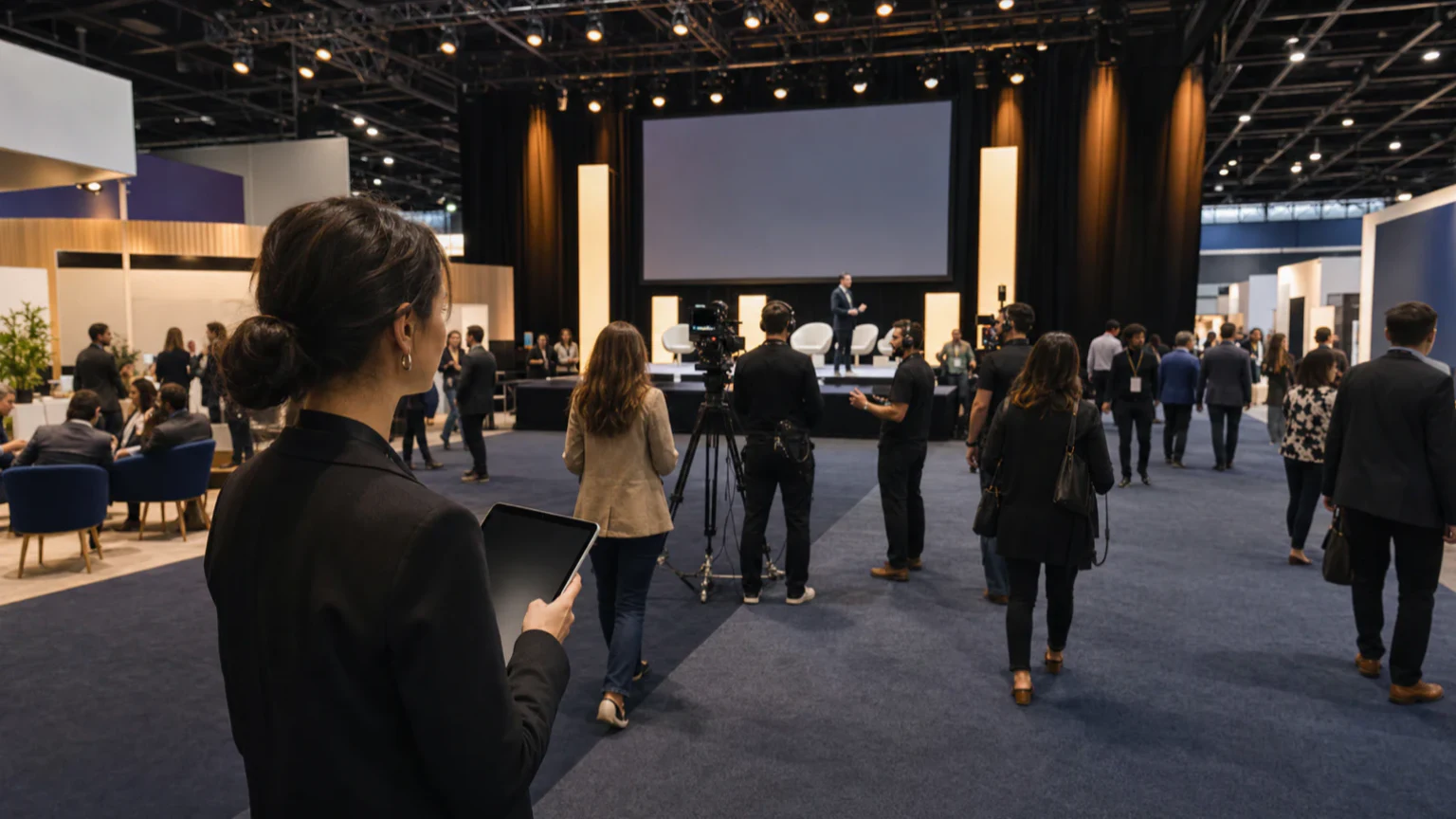
One of the clearest lessons from live media is that place matters. A live segment feels different when it happens where the action is.
Trade shows can apply that by treating the floor as an active storytelling environment, not just a backdrop.
That could mean building short live formats around:
- product launches from exhibitor booths
- rapid interviews with buyers or speakers
- theme-based floor walks
- daily trend recaps from a central stage
- sponsor-supported demonstrations with clear time windows
The operational benefit is that these formats create predictable moments of attention. Instead of hoping attendees drift toward interesting activity, the organizer creates scheduled reasons to move.
But this only works if floor operations are prepared for it. Organizers need to think through audio spill, aisle congestion, sightlines, staffing, and timing conflicts with nearby sessions.
Sponsorship becomes easier when the content has shape
Many trade show sponsorship packages still rely on familiar inventory: logo placement, booth upgrades, lanyards, signage, and sponsored sessions.
Those still matter, but live storytelling creates more structured inventory if it is designed carefully.
For example, a sponsor package could be tied to:
- a recurring live interview segment
- a themed innovation update each morning
- a sponsored floor spotlight series
- a closing recap segment
- category-specific demo coverage
The important point is not to overload the event with branded interruptions. It is to create sponsor moments that feel native to the audience experience.
That requires tighter event operations than a standard logo placement package. The team has to manage run-of-show details, intros, host cues, location readiness, exhibitor coordination, and content approvals.
In other words, better sponsor storytelling usually depends on better production discipline.
What this changes for attendee engagement
Attendees rarely experience an event as a clean split between “content” and “exhibition.” They experience momentum, friction, discovery, and overload.
A more media-shaped event can improve engagement in a few practical ways:
- it gives attendees clearer reasons to be in specific places at specific times
- it reduces agenda fatigue by highlighting priority moments
- it makes sponsor activations feel more contextual
- it turns floor discovery into a guided experience, not only a search task
This is also where AI-assisted attendee support could become relevant in a limited, practical sense.
If an event has clear content blocks, live highlights, and structured floor moments, digital guidance becomes more useful. Attendees can be pointed toward relevant sessions, nearby demos, or sponsor activations based on their interests and available time.
That does not require grand claims about AI. It requires clean event data, timely updates, and a believable attendee journey.
The operational risks are easy to underestimate
It is tempting to make trade shows feel more like live media by adding hosts, cameras, clips, and branded segments. But the production layer can create failure points if the basics are loose.
Common risks include:
- agenda changes that break planned live coverage
- audio conflicts between content zones and booths
- crowding around activation points
- sponsors expecting coverage that staff cannot deliver consistently
- unclear ownership between event operations, exhibitors, and production teams
- participant confusion about what is happening live versus what is simply being promoted
These are not abstract concerns. They are ordinary event-day issues made more visible by live formatting.
If an organizer wants a broadcast-style layer, they need to define ownership early. Who controls the run of show? Who approves sponsor mentions? Who updates location changes? Who handles on-site timing recovery when a segment runs late?
Without that clarity, the event may feel more ambitious, but also more fragile.
A practical model for testing the idea
Organizers do not need to redesign an entire trade show around media logic in one step.
A more sensible pilot is to choose one event zone, one sponsor category, or one content track and structure it more deliberately.
A simple test could look like this:
- Choose three to five anchor moments across the day.
- Assign a clear format to each one, such as interview, demo, recap, or guided floor spotlight.
- Connect each moment to a specific attendee outcome, such as traffic to a zone, session attendance, or exhibitor discovery.
- Package limited sponsor participation around those moments.
- Measure whether attendees actually followed the flow.
This makes the experiment manageable. It also produces evidence the team can review later.
What to measure if you try this
If organizers want to know whether a live storytelling layer helped, they should focus on operational and behavioral signals, not just impressions.
- attendance at anchor sessions or floor segments
- traffic lift near featured exhibitor zones
- dwell time around programmed activations
- sponsor satisfaction with the format
- staff effort required to run the experience
- attendee feedback on clarity and usefulness
- drop-off between promoted moments and actual participation
The goal is to learn whether the format improved navigation and value, or simply added complexity.
What this may mean for the next generation of trade shows
The strongest takeaway is not that trade shows should imitate television literally.
It is that many events would benefit from stronger editorial structure. Better sequencing. Better spotlighting. Better links between content, commerce, and sponsorship.
Trade shows already contain live stories. New products launch. buyers compare options. Experts frame market shifts. Sponsors want meaningful association. Attendees want help deciding where to spend limited time.
When those elements are connected more intentionally, the event becomes easier to follow and easier to sell.
That is the useful lesson in the media comparison.
Not every event needs a broadcast layer. But more events could benefit from thinking like a producer for at least part of the attendee experience.