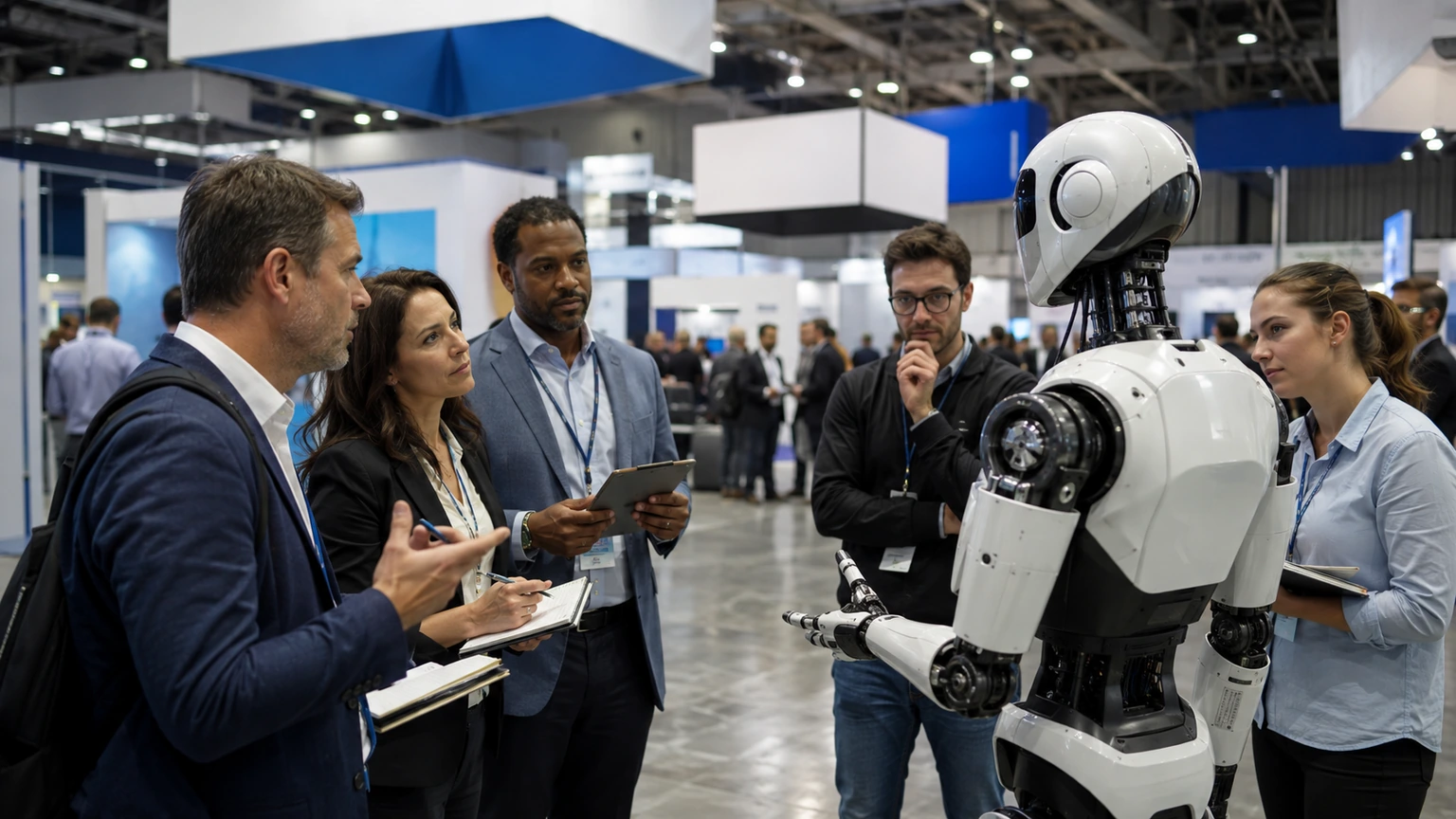
Humanoid robotics demos are becoming more visible at major trade shows.
Recent coverage of IFA 2026, including bgr.com's roundup of standout humanoid robots at the show, points to a simple reality for event organizers: these demos attract attention. That does not automatically make them good event activations. It does make them worth evaluating seriously.
For convention teams, the practical question is not whether humanoid robots look impressive on camera. It is whether a robotics demo helps attendees engage more deeply with the show, the exhibitor mix, and the live event experience.
A strong robotics demo does more than create a crowd. It gives people a reason to stop, watch, ask questions, and continue exploring the event.
Why this matters
Large conventions compete for attendee attention from every direction: sessions, booths, networking, product launches, and sponsor activations.
A humanoid robot demo can cut through that noise quickly. People notice movement, interaction, and unfamiliar technology faster than they notice most static displays.
That can help events in several ways:
- increase footfall in specific zones
- create visible energy on the show floor
- encourage social sharing and word-of-mouth
- give exhibitors a stronger conversation starter
- help attendees remember a product area or event section
Still, attention is only the first layer of engagement. Organizers need to ask what happens after the crowd forms.
What attendee engagement actually looks like in practice
When event teams say they want more engagement, they often mean a mix of behaviors:
- attendees stopping instead of walking past
- people staying longer in a zone
- more questions asked at stands
- better interaction between staff and visitors
- more onward movement to related exhibitors or sessions
- higher levels of sharing, photos, and discussion
A humanoid robotics demo can support these outcomes, but only if the activation is designed around them.
If the robot is present only as a spectacle, the result may be a brief crowd with limited commercial or educational value. If the demo is tied to a clear story, attendees are more likely to leave with context, not just a photo.
Where humanoid robotics demos tend to work best
Not every event format benefits equally from this kind of showcase.
Humanoid robot demos are usually strongest in environments where discovery and product curiosity already matter:
- technology trade shows
- innovation expos
- industrial and manufacturing events
- future-of-work conferences
- electronics and consumer tech conventions
- sponsor or partner showcase zones
They may be less effective in events where the audience is highly agenda-driven and spends limited time browsing exhibition space.
That does not mean they cannot work. It means the placement, timing, and positioning need more care.
Start with the operational goal, not the robot
A common mistake is treating the robot itself as the strategy.
It is better to define the job the demo needs to do. For example:
- draw attendees into a new expo area
- support a headline sponsor activation
- increase dwell time near a product category
- create a scheduled crowd moment during quiet hours
- add a practical demonstration to a content track on robotics or automation
Once that goal is clear, the team can judge whether a humanoid format is actually the right fit.
The best demo activations are designed backwards from attendee behavior: where do we want people to go, what do we want them to understand, and what should they do next?
How to evaluate a robotics demo before approving it
The source coverage behind this article shows market interest, not an operations manual. That means organizers should stay disciplined during vendor evaluation.
Useful questions include:
Is there a clear demo script?
Ask what attendees will actually see in a two-minute, five-minute, and ten-minute interaction.
If the answer is vague, the live experience may rely too heavily on novelty.
Can the demo run repeatedly under event conditions?
A convention floor is noisy, crowded, and unpredictable. A demo that works in a filmed product setting may struggle on site.
Ask how the activation performs with:
- ambient noise
- variable lighting
- dense foot traffic
- queue build-up
- interrupted power or connectivity planning
What is the staffing model?
Even if a robot is the headline, people still manage the experience. Organizers should know:
- who operates the demo
- who resets it between cycles
- who answers attendee questions
- who handles exceptions or stoppages
- who makes the stop-call if safety or congestion becomes a problem
What happens after the crowd forms?
This is one of the most important questions. If a hundred people stop to watch, what comes next?
Good answers might include a nearby product explanation, a staffed handoff, a scheduled talk, or a route to related exhibitors.
Plan for flow, not just attention
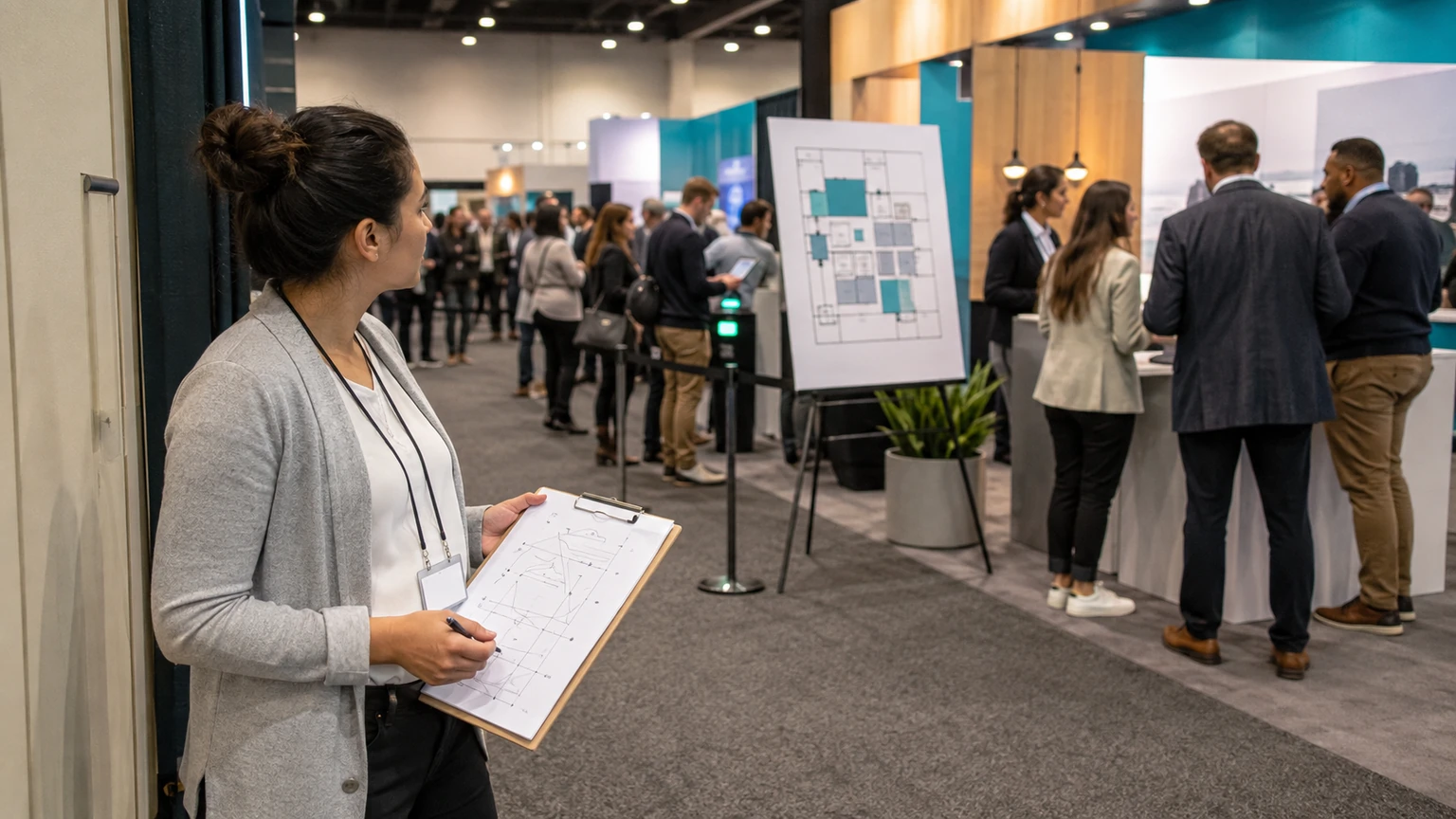
One of the biggest operational risks with eye-catching demos is congestion.
A robot that draws a large crowd can create secondary problems fast:
- blocked aisles
- unsafe stopping points
- noise spill into neighboring booths
- reduced visibility for adjacent exhibitors
- staff difficulty managing line formation
That is why floor placement matters as much as the demo itself.
For many events, the safest options are wider activation zones, feature areas, end-cap spaces, or programmed demonstration stages where audience gathering is expected.
If the robot is placed in a standard inline booth footprint, crowd management needs to be reviewed carefully.
Think about neighboring exhibitors too
A high-interest demo can help a zone, but it can also distort it.
Organizers should consider whether the activation will:
- benefit surrounding stands through increased traffic
- overpower nearby exhibitors with noise or crowd density
- change normal movement patterns through the hall
- require special queue barriers or aisle supervision
This matters because attendee engagement is not just about one impressive moment. It is about how the show floor performs as a whole.
If a robotics demo becomes a bottleneck, the event may gain attention while losing usability.
Use timed demos to create better engagement
Scheduled demonstrations often work better than constant passive display.
Timed demo slots can help teams:
- build anticipation
- spread attendance across the day
- brief staff properly before each cycle
- control crowd size more effectively
- connect demos to hosted commentary or Q&A
This also helps attendees understand when to return, rather than clustering around an unclear activation that may or may not begin soon.
Simple signage and app listings can reinforce the schedule.
Make the story easy to understand
Many robotics demos fail at the explanation layer.
Attendees may find the robot interesting without understanding what is being shown, why it matters, or how it connects to the exhibitor's offer.
To avoid that, teams should keep the interpretation simple:
- what the robot is demonstrating
- what problem it is meant to help solve
- what is live versus pre-programmed
- what attendees should notice during the interaction
- where to go for a deeper conversation
This can be delivered by booth staff, a moderator, or short supporting signage.
Safety and service design should be visible
Organizers do not need to overstate risk to treat robotics demos seriously.
Any moving, crowd-attracting activation should have clear operational controls. Depending on the setup, that may include:
- defined demo perimeter
- staffed supervision
- start and stop procedures
- queue guidance
- fallback plans if the demo pauses or fails
Attendees usually do not need a long technical explanation. They do need an experience that feels orderly, safe, and well-managed.
How to judge whether the demo worked
Success should be measured by more than social buzz.
After the event, teams can review practical indicators such as:
- footfall around the activation
- dwell time
- number of completed demo cycles
- quality of exhibitor conversations after the demo
- lead capture or meeting volume, if relevant
- impact on nearby zone traffic
- staff feedback on crowd management
This helps separate a memorable spectacle from a useful show-floor investment.
What this means for event teams
The signal from IFA 2026 is not that every convention now needs a humanoid robot. It is that robotics demos are becoming more visible in trade show environments, and organizers should be ready to evaluate them with clear operational criteria.
For the right audience and setting, a humanoid demo can improve attendee engagement by creating curiosity, dwell time, and stronger interaction on the floor.
But the real value depends on planning: placement, staffing, safety, timing, and a clear attendee story.
If event teams treat humanoid robotics as an engagement tool rather than a headline prop, they are more likely to turn attention into something useful.