
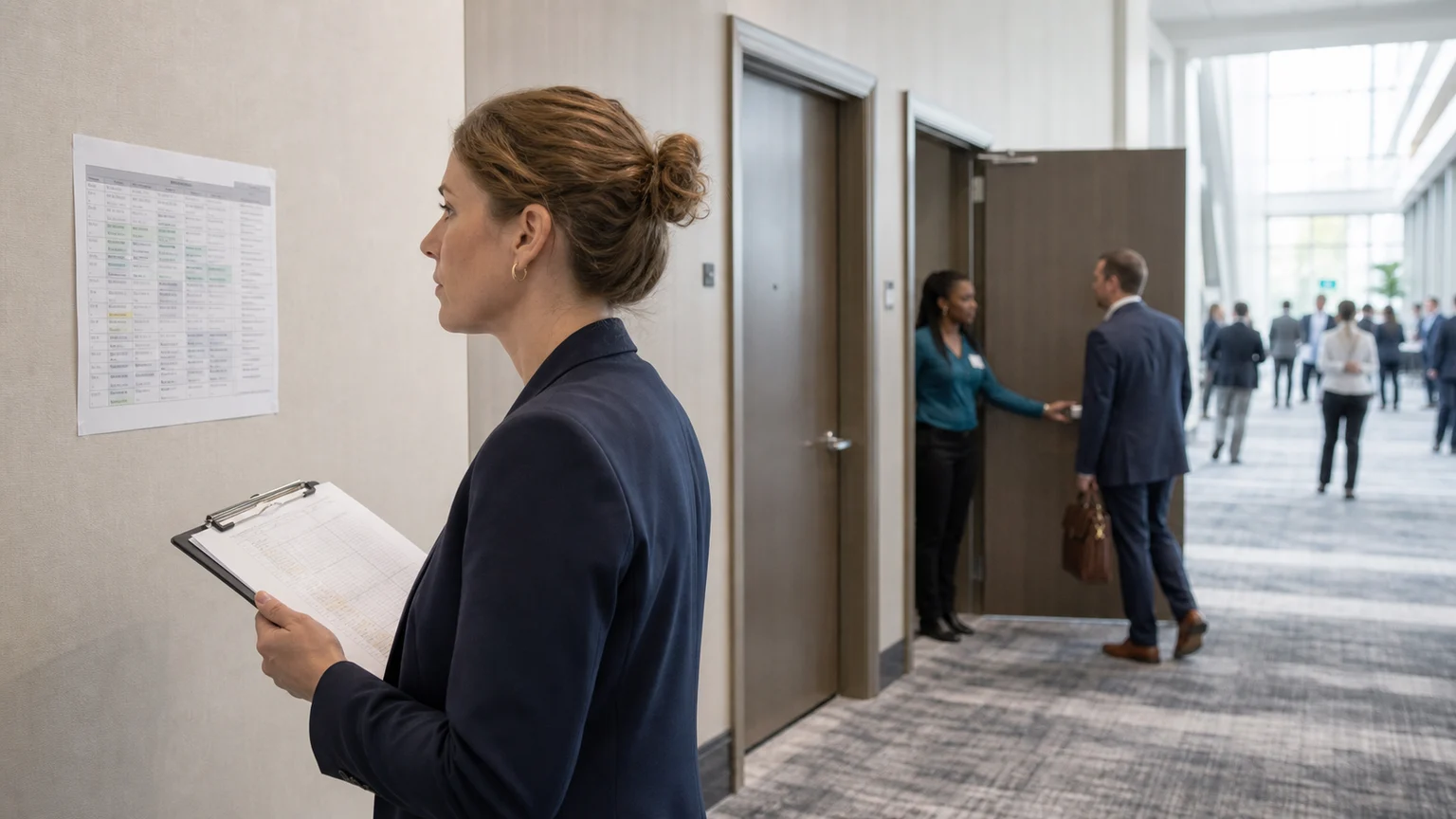
Private meeting rooms are often one of the most useful, and most easily strained, parts of a conference operation.
When a conference opens bookings for private meeting rooms, it usually signals real demand from sponsors, hosted buyers, exhibitors, partners, and leadership teams who need quieter space for commercial or sensitive conversations.
That demand can create value, but it can also create friction if room inventory, booking rules, access control, and on-site support are not managed tightly.
A private meeting room is not just a space product. It is a schedule, access, service, and turnover problem that has to run cleanly under pressure.
Why this matters
At many conferences, private rooms support some of the highest-value interactions happening on site:
- sponsor and buyer meetings
- partnership discussions
- press briefings
- speaker preparation
- board or leadership meetings
- commercial negotiations that should not happen on the open floor
If the room programme is handled well, it improves attendee experience and protects important business conversations.
If it is handled badly, the problems show up quickly: double bookings, late starts, unclear ownership, disputes over priority, empty rooms being held, or staff spending the day resolving avoidable confusion.
Start with a clear room inventory
Before taking a single booking, confirm exactly what inventory is truly available.
That sounds obvious, but room programmes often fail because teams start selling or assigning space before validating operational reality.
Review each room against practical criteria:
- capacity and furniture setup
- location relative to the main event flow
- access restrictions
- noise level and privacy
- AV availability
- power and connectivity
- cleaning and reset time needed between meetings
- staffing requirements
Not all private rooms are equal. If one room is near the keynote hall and another is down a service corridor, they should not be treated as the same product.
Define the booking model early
One of the biggest operational decisions is simple: who gets access to book, and under what rules?
Common models include:
- invite-only booking for sponsors, hosted buyers, or senior stakeholders
- tiered access based on package level
- first-come, first-served access within a controlled audience
- internal allocation by the organizer rather than self-service selection
Each model has trade-offs.
A fully open approach may feel fair, but it can lead to rushed booking behaviour and poor room utilisation. A tightly controlled allocation process takes more work, but it often produces better use of limited space.
The fairest booking policy is not always the most effective one. The best policy is the one that fits the event's commercial priorities and the actual room supply.
Set rules that reduce misuse
Private rooms are limited inventory. That means the booking policy needs more than a calendar.
At minimum, organizers should define:
- minimum and maximum booking lengths
- how far in advance rooms can be reserved
- whether repeat bookings are capped
- whether buffer time is built in between sessions
- when unconfirmed bookings are released
- what happens in no-show situations
- who can approve exceptions
Without these rules, the schedule often gets distorted by a small number of users holding too much of the inventory.
For example, allowing one group to reserve a room for an entire day may seem convenient, but it can reduce the value of the programme for everyone else unless that exclusivity was planned and sold intentionally.
Match room types to meeting types
Not every meeting needs the same environment.
Some conferences make the mistake of treating all private room demand as interchangeable. In practice, the needs are usually quite different.
Short commercial meetings
These usually need efficient scheduling, easy access, and fast room turnover.
VIP or leadership meetings
These need stronger privacy, more reliable access control, and often a better hospitality standard.
Press or media briefings
These may need tighter time discipline and clearer support for arrivals and handovers.
Speaker preparation or internal staff use
These should be protected in the plan, not squeezed into leftover availability at the last minute.
Segmenting room use this way helps avoid wasting high-value rooms on low-need use cases, or overcomplicating simple meeting demand.
Build realistic turnaround time into the schedule
One of the most common mistakes in room management is scheduling meetings back to back with no operational buffer.
That usually fails in live conditions.
Even a simple private room may need time for:
- participants to leave and arrive
- basic reset of chairs or tables
- refreshment clearance
- AV checks
- cleaning
- staff handover
If the room calendar looks efficient on paper but impossible on site, delays will cascade through the day.
In many cases, a shorter bookable slot with a built-in buffer performs better than a longer nominal schedule that assumes perfect punctuality.
Protect access and wayfinding
A booked room is only useful if people can find it and enter it without friction.
That means access planning matters just as much as room allocation.
Organizers and venue teams should confirm:
- how attendees will be directed to the room area
- whether the area needs staffed access control
- how room occupants will be verified
- what signage is appropriate without compromising privacy
- how late arrivals or substitutions will be handled
For higher-value meetings, too much public signage can become a problem. For general meeting programmes, too little signage creates support issues. The right balance depends on the event and the stakeholder mix.
Clarify service levels before selling the space
Private meeting rooms often create mismatched expectations because the buyer assumes a higher level of support than the operations team intended to provide.
Be specific about what is and is not included.
That may cover:
- room setup type
- screen or monitor access
- Wi-Fi or wired connectivity
- water or refreshments
- host or concierge support
- printing or stationery
- cleaning frequency
- technical assistance
This is especially important when rooms are sold as part of sponsorship or premium attendee packages. Ambiguity creates disputes close to the event, when changes are hardest to absorb.
Assign operational ownership
Private rooms can fall awkwardly between sales, event operations, venue operations, hospitality, and on-site support teams.
That creates risk.
Someone needs clear ownership for the full workflow, including:
- inventory control
- booking approvals
- stakeholder communication
- change management
- room-day issue resolution
- reporting after the event
If ownership is split without a lead, small issues escalate fast. A room appears available in one document, blocked in another, and promised by a third team to someone else.
A single owner does not have to do all the work, but one person or function should be accountable for the truth.
Plan for changes, not just confirmed bookings
Conference schedules move. Senior attendees run late. Sponsors ask for swaps. A buyer meeting gets upgraded from 30 minutes to 60. A speaker suddenly needs a quiet room.
The room plan should expect these changes.
A practical approach includes:
- a small reserve of unallocated time or space
- a documented escalation path for urgent requests
- a waitlist process
- clear cut-off times for same-day changes
- staff who can make decisions quickly on site
Trying to run a private room programme at full theoretical utilisation with no flexibility often backfires.
Use simple communication templates
Many room problems are really communication problems.
Attendees and sponsors should not have to guess:
- when the booking is confirmed
- where the room is
- what the booking includes
- when they can arrive
- how long they have the room
- who to contact for help
- what happens if they are late
Short, standardised pre-event and on-site messages reduce support volume and protect staff time.
They also make the service feel more controlled and professional.
Track utilisation, not just bookings
A full schedule does not always mean good use.
After the event, review how the rooms were actually used.
Useful questions include:
- Which rooms were booked most often?
- Which time slots were hardest to fill?
- How many no-shows occurred?
- Were premium rooms used appropriately?
- How many change requests happened on site?
- What support issues repeated?
- Did buffer times hold up in practice?
This matters because next year's room programme should be built on operational evidence, not assumptions.
Common mistakes to avoid
- selling room access before validating true inventory
- using the same rules for all stakeholder groups
- allowing excessive holds without confirmation deadlines
- scheduling unrealistic back-to-back bookings
- failing to define service inclusions clearly
- splitting ownership across teams with no lead
- treating private rooms as a minor add-on rather than a live operational function
A practical checklist for conference teams
- confirm every usable room and its real condition
- classify rooms by suitability, not just size
- define who can book and under what rules
- set booking limits, buffers, and release deadlines
- document service inclusions and exclusions
- assign one operational owner
- prepare signage, access control, and attendee instructions
- build a process for changes and urgent exceptions
- brief on-site staff on escalation paths
- review actual utilisation after the event
What this means for event teams
Private meeting rooms can be a strong part of conference value, especially when events are trying to support more structured networking, hosted meetings, sponsor ROI, or executive engagement.
But they only work well when treated as an operational system, not just spare space on the floorplan.
For organizers and venue teams, the goal is straightforward: make room access clear, fair, realistic, and easy to run under live event conditions.
When that happens, private rooms stop being a source of friction and start becoming one of the most dependable parts of the event experience.