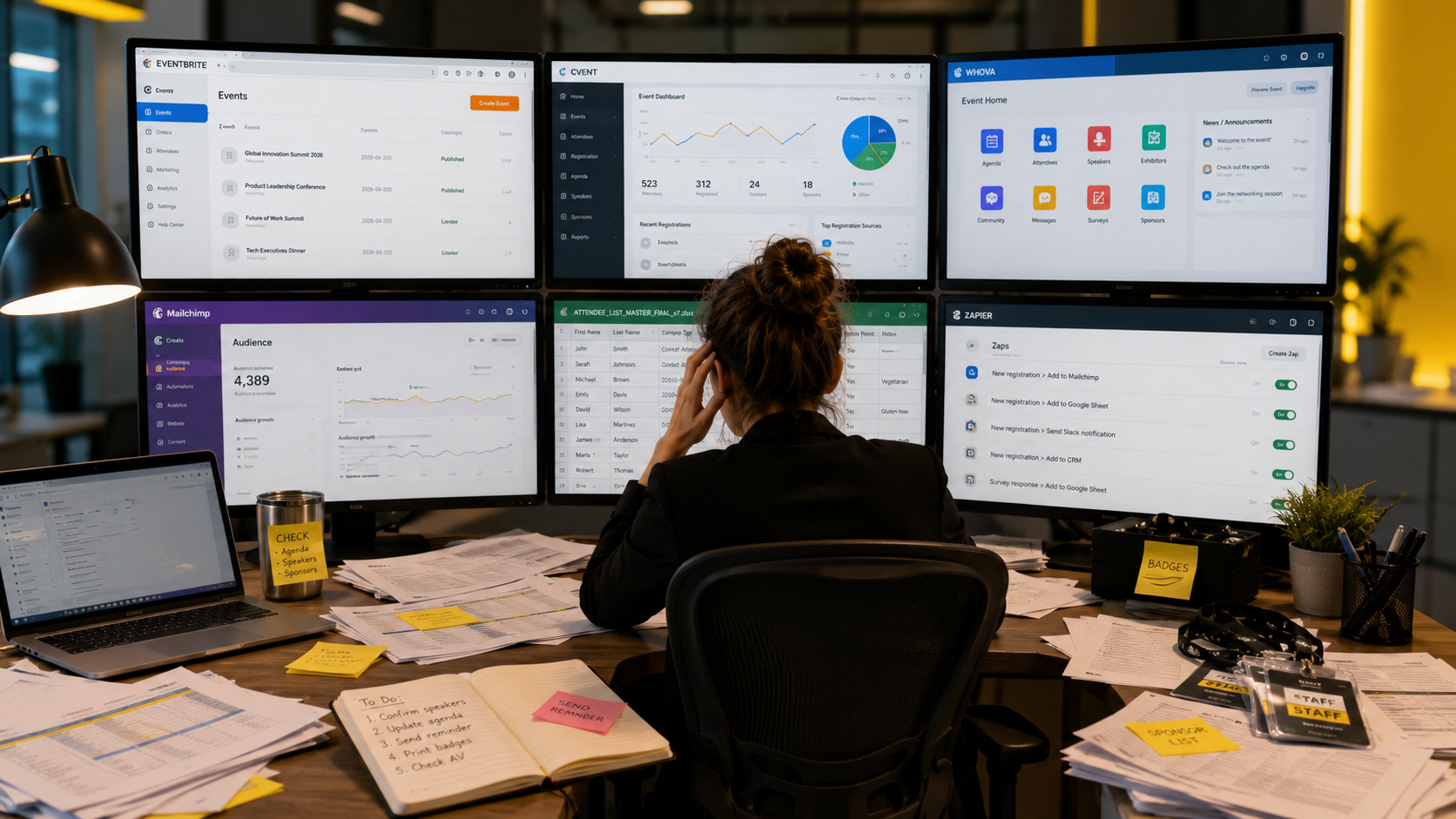
If you've organized an event recently, you've probably experienced this situation:
- One platform for registrations
- Another for ticket sales
- Another for attendee communication
- Another for check-in
- Another for surveys
- Several spreadsheets connecting everything together
Individually, these tools may work perfectly well.
Together, they often create an operational headache that grows with every attendee, sponsor, speaker, and last-minute change.
Your event shouldn't require six logins and three spreadsheets just to function.
How Did We Get Here?
Most event technology was built to solve a specific problem.
Registration systems focused on registrations. Event apps focused on attendee engagement. Survey platforms focused on feedback collection.
The problem is that events don't happen in isolated pieces.
A speaker update affects the agenda. The agenda affects attendees. Attendees affect communications. Communications affect check-in and participation.
Everything is connected.
Unfortunately, many event tools were not designed that way.
The Spreadsheet Always Returns
No matter how modern the software stack appears, spreadsheets somehow find their way back into the process.
- Export attendees from one platform
- Clean the data manually
- Import it somewhere else
- Update changes
- Repeat when registrations change
Spreadsheets are powerful tools.
But they were never meant to become the central nervous system of an event.
Yet for many organizers, that's exactly what happens.
The Cost Nobody Talks About
When evaluating event technology, most comparisons focus on pricing.
But subscription costs are only part of the picture.
The bigger cost is often operational complexity.
- Hours spent importing and exporting data
- Staff training across multiple systems
- Duplicate information
- Participant confusion
- Support requests that shouldn't exist
A platform might save a few euros per month while costing dozens of hours throughout the event lifecycle.
What Organizers Actually Need
Most organizers are not searching for more features.
They are searching for fewer headaches.
The ideal event setup should allow organizers to:
- Manage registrations
- Communicate with attendees
- Publish agendas
- Handle check-in
- Manage sponsors and speakers
- Track participation
Without constantly moving data between systems.
Complexity Doesn't Scale
An event with 50 attendees can survive a messy process.
An event with 500 attendees starts exposing every weakness.
An event with 5,000 attendees turns those weaknesses into serious operational risks.
The larger the event becomes, the more valuable simplicity becomes.
Every extra system creates another opportunity for something to break.
The Future Of Event Management
The future of event technology isn't necessarily more features, more dashboards, or more integrations.
It's reducing the amount of work required to deliver a great event.
Because organizers should spend their time creating memorable experiences, not moving data between systems.
And perhaps most importantly, no event should require six logins and three spreadsheets to succeed.