
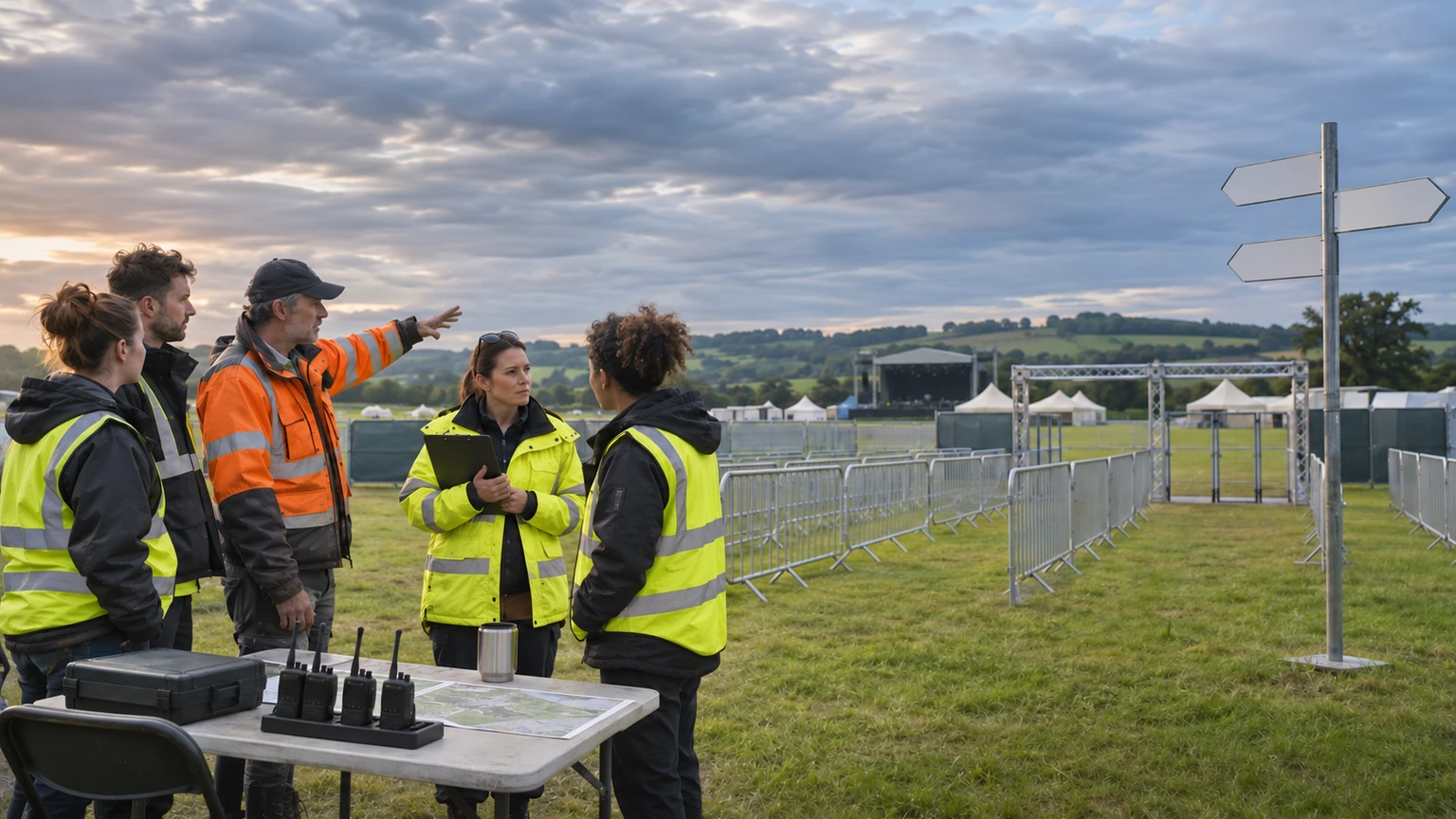
Safety at large outdoor events cannot sit in a separate document that only appears during licensing or final sign-off.
It has to shape the event from the start: site design, scheduling, staffing, supplier coordination, audience communication, and relationships with local authorities and communities.
The source signal behind this topic is useful but narrow. A public industry discussion that puts safety and community at the heart of the outdoor events agenda is enough to show where organiser attention is going. It is not enough to claim specific operational standards, incident data, or event outcomes that are not confirmed in the source.
A safety-first event plan is not only about emergency response. It is about reducing avoidable risk before the gates open.
Why this matters for event operations
Outdoor events usually bring more variables than controlled indoor environments.
Teams may be managing:
- weather exposure and changing ground conditions
- temporary infrastructure
- multiple access points and perimeter risks
- higher travel and transport complexity
- mixed audience behaviour across long dwell times
- noise, traffic, and welfare concerns for local communities
- contractors and partners working across a large footprint
When safety planning is weak, the consequences spread quickly. Queues become harder to manage, staff make inconsistent decisions, welfare issues escalate, and community trust can drop even if the event itself still takes place.
What we can say, and what we cannot
Based on the source idea, it is reasonable to say that safety and community considerations are being treated as central topics in outdoor event planning.
What we cannot claim from that signal alone is:
- the exact guidance given at any named conference or convention
- which control measures are now standard across the sector
- whether any one event model has been validated as best practice everywhere
- specific legal or regulatory requirements in every jurisdiction
That matters because large outdoor events vary widely. A city-centre festival, agricultural show, music weekender, charity run, and rural family event may all face different risk profiles.
Treat public industry signals as useful direction, then build the plan around your actual site, crowd, partners, and operating conditions.
Start with a realistic risk picture
Many teams begin safety planning with templates. Templates are useful, but they should not replace a fresh reading of the event.
Start by defining the conditions that make this event operationally different. For example:
- expected audience size and arrival pattern
- open-access versus ticketed entry
- site terrain, pinch points, and evacuation routes
- alcohol service and late-night activity
- family audiences, vulnerable guests, or accessibility needs
- weather sensitivity of staging, power, catering, and welfare areas
- nearby residents, businesses, schools, or transport hubs
This step helps organisers avoid generic plans that look complete on paper but miss the real pressure points.
Build safety into site design early
Site planning is one of the clearest places where safety and operations meet.
Before finalising layouts, test whether the site supports safe movement and straightforward decision-making for attendees and staff.
Key questions for the layout
- Are entrances and exits sized for realistic peaks, not average flow?
- Can emergency vehicles access critical areas without confusion?
- Are there obvious bottlenecks near bars, toilets, stages, bridges, or crossings?
- Can attendees find welfare, water, medical, and information points easily?
- Are back-of-house routes separated from public movement where possible?
- Do fencing, barriers, and wayfinding support calm movement rather than reactive crowd control?
If the layout creates friction, staffing alone rarely fixes it.
Plan for weather as an operating condition, not a footnote
Weather planning is often treated as a contingency section near the end of the process. For outdoor events, that is usually too late.
Weather can affect:
- ground stability and slip risk
- stage and structure safety
- queue comfort and crowd patience
- power reliability
- visibility and signage legibility
- travel times for staff, artists, suppliers, and attendees
- welfare demand, especially for heat, cold, rain, or wind exposure
A practical weather plan should define thresholds, decision owners, communication routes, and fallback actions. It should also cover less dramatic but common problems, such as rain turning access lanes into delays that then affect entry and staffing.
Do not separate crowd management from programming
At large outdoor events, crowd pressure is often created by the programme itself.
Stage timings, headline moments, parade routes, fireworks, popular activations, and limited-capacity zones can all create sudden movement patterns.
That means safety planning should sit close to scheduling decisions. Useful checks include:
- staggering major moments where possible
- avoiding unnecessary timetable clashes that push crowds between distant zones at once
- planning buffer time after high-demand segments
- reviewing whether popular attractions need managed access
- aligning food, toilet, and welfare provision with dwell points
Programme design is not just a content decision. It is a crowd-shaping decision.
Make community impact part of the safety plan
For large outdoor events, community planning is not separate from safety planning. The two are often linked.
Residents and local stakeholders are affected by traffic, noise, road closures, pedestrian flows, waste, overnight activity, and emergency access. If those relationships are weak, operational issues can escalate faster and trust can drop between editions.
Practical community measures often include:
- clear pre-event notices about timings and restrictions
- published contact routes for resident concerns
- traffic and access plans that protect local movement where possible
- coordination with nearby businesses and services
- noise management processes with defined review points
- post-event follow-up when disruption has been significant
Community communication will not remove every complaint, but it usually improves predictability and reduces avoidable friction.
Staffing needs clarity more than volume
Adding more staff does not automatically create a safer event. What matters is whether people know their role, escalation path, and decision limits.
For large outdoor events, teams often include stewards, security, medical providers, production crews, volunteer groups, caterers, cleaning teams, and local partners. Problems emerge when each group works from a different picture of the event.
Cover these points in operational briefings
- site objectives and major risk areas
- incident reporting expectations
- radio or communications protocol
- lost child or vulnerable person procedures
- welfare escalation routes
- weather response actions
- crowd pressure indicators and who decides next steps
- public messaging responsibilities
Short, repeatable briefings are usually more effective than long documents that frontline teams do not absorb.
Put welfare on equal footing with security
Safety-first planning works better when welfare is treated as a core operating function, not an optional support layer.
At outdoor events, many situations start as welfare issues before they become security or medical issues. People may need shade, water, rest, directions, emotional support, charging, or help reconnecting with their group.
Consider whether attendees can quickly find:
- first aid and medical support
- water points
- toilets and accessible facilities
- welfare or quiet spaces where relevant
- information points with trained staff
- safe help routes after dark
Good welfare design reduces escalation and improves the overall feel of the event.
Use communications to prevent avoidable risk
Many operational issues worsen because attendees do not know what is happening, where to go, or what to expect.
Clear communication should begin before arrival and continue on site. Focus on practical information:
- entry times and prohibited items
- travel and parking guidance
- weather preparation advice
- site maps and zone names
- welfare and medical locations
- changes to timings or access conditions
- exit guidance at the end of the event
Simple language matters. In a busy outdoor environment, people need instructions they can understand quickly.
A practical planning sequence
For teams building or refining a safety-first approach, this order is usually workable:
- define the event's specific risk profile
- review the site layout against movement, access, and welfare needs
- align programme decisions with likely crowd behaviour
- set weather triggers and response ownership
- coordinate plans with authorities, suppliers, and key contractors
- prepare resident and community communication
- brief staff by role, with clear escalation routes
- test scenarios before live delivery
- review incidents and near misses after the event
This keeps safety tied to real operational decisions, rather than isolated in compliance paperwork.
Questions worth asking before final sign-off
- What are the three most likely operational safety problems at this event?
- Where could crowd pressure build faster than expected?
- How will weather change the site after several hours, not just at opening?
- Can a first-time attendee find help within a few minutes?
- Do residents know what to expect and how to reach the organiser?
- Would frontline staff describe the emergency and welfare plan the same way?
- Which decisions depend too heavily on one person being available?
Where teams should be careful
There are a few common mistakes in large outdoor event planning:
- copying last year's plan without re-testing assumptions
- overestimating how much signage alone will solve movement issues
- treating welfare as secondary to perimeter control
- briefing suppliers too late on safety-critical expectations
- assuming community concerns are mainly a public relations issue
- building contingency plans that do not name actual decision owners
Most of these are preventable when teams integrate safety early and revisit it as the event design develops.
What good looks like
A well-run outdoor event usually feels calm, legible, and coordinated.
Attendees can find their way. Staff know what to do. Welfare is visible. Communications are timely. Local stakeholders are informed. When conditions change, the team adapts in a structured way rather than improvising under pressure.
That does not mean risk disappears. It means the event is designed to handle predictable strain more reliably.
What this means for event teams
The most useful lesson from the current industry focus on safety and community is simple: outdoor event safety is not only a compliance requirement. It is a design discipline.
For organisers, venue operators, and festival producers, the practical opportunity is to move safety conversations earlier in the planning cycle and keep them connected to programming, layout, staffing, and local relationships.
That is usually where safer events, smoother operations, and stronger community confidence begin.