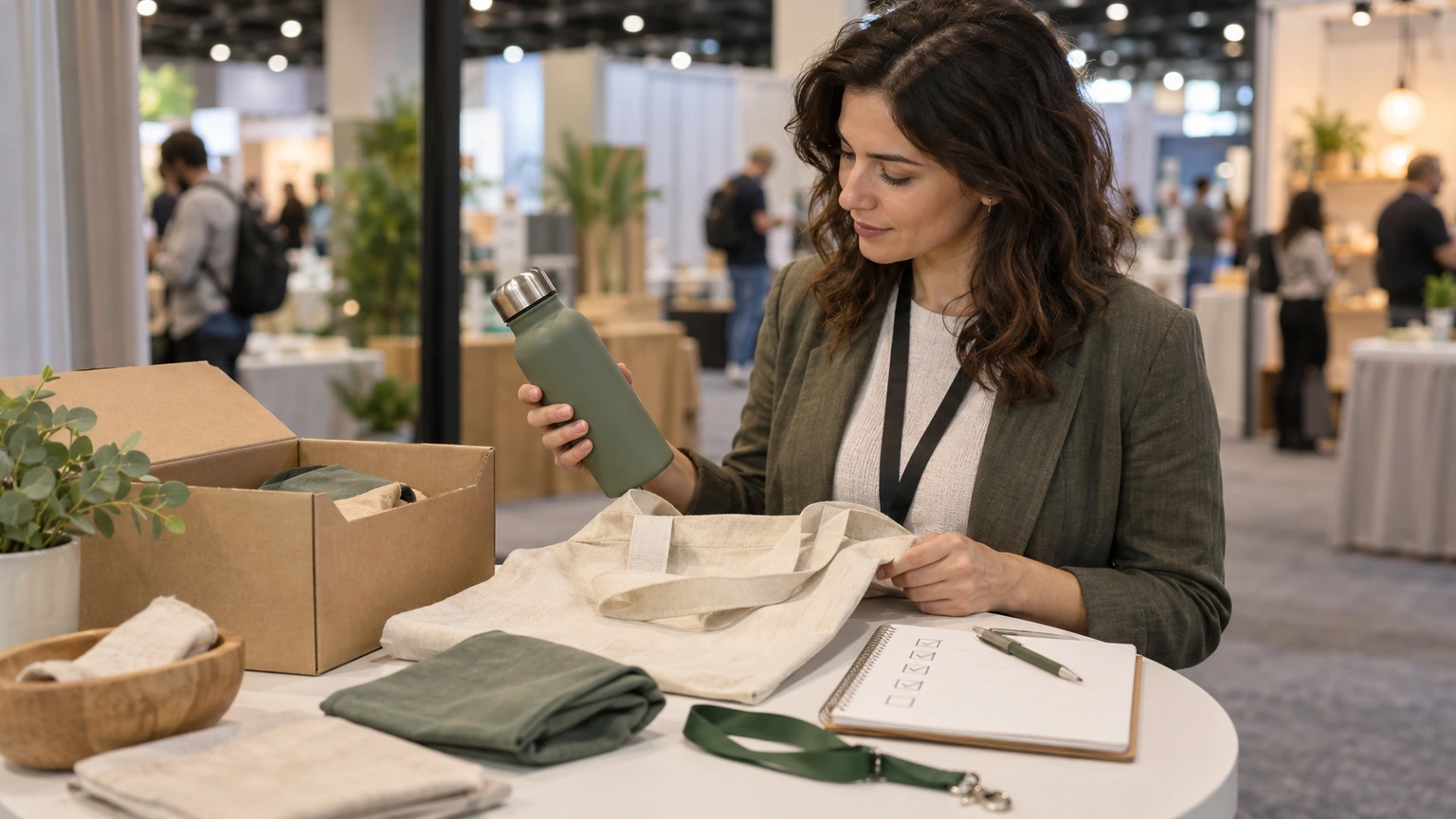
Branded giveaways are still part of the exhibitor playbook.
They can help start conversations, reinforce a brand, and give booth staff something useful to offer after a good meeting.
But promo items also create a familiar sourcing problem: suppliers use words like eco-friendly, sustainable, and responsibly made, while procurement teams still need to decide what is actually credible.
That is the gap exhibitors need to manage.
Based on the source idea here, the useful takeaway is simple: move from broad claims to supplier evidence. Ask better questions before the order is placed, especially when timelines are tight and event delivery dates are fixed.
If a sustainability claim matters enough to influence the order, it should be specific enough for a supplier to explain.
Why this matters for exhibitors
Promo-item decisions are rarely just about the item itself.
They affect budget, shipping, booth logistics, storage, on-site distribution, and brand risk. A weak sourcing decision can leave a team with late delivery, unclear claims, poor item quality, or too much leftover stock after the show.
For exhibitors, the operational questions are practical:
- Will this item arrive on time?
- Can the supplier back up its claims?
- Is the quantity realistic for booth traffic?
- Will attendees actually keep and use it?
- Does the item fit the event audience and brand?
Those questions matter more than a nice label on a sales sheet.
What we can say, and what we should not assume
The source cited for this post points to a timely procurement theme: exhibitors should ask merchandise suppliers more rigorous questions and evaluate environmental claims with evidence, not buzzwords.
That is enough to support a practical checklist.
What it does not give us on its own is:
- a universal certification standard for every promo category
- a confirmed list of approved materials for every event
- proof that any one supplier's claim is valid or invalid
- a guarantee that a higher-claimed item is always the better operational choice
That distinction matters because good sourcing is rarely one-question simple. It is usually a comparison exercise across claims, cost, timing, and fit for purpose.
Evidence-aware buying does not mean buying the most expensive item. It means buying the item you can defend.
A practical checklist for vetting promo items
1. Ask what the claim actually means
Start with the wording the supplier is using.
If a product is described as sustainable, recycled, biodegradable, low-impact, or responsibly sourced, ask for a plain-language explanation of that exact claim.
Useful follow-up questions include:
- Which part of the item does the claim apply to?
- Is it the material, packaging, manufacturing process, shipping method, or all of the above?
- Is the claim about the whole product or only one component?
This is often where vague marketing language becomes easier to test.
2. Request documentation, not just reassurance
Exhibitors do not need to become auditors, but they should ask suppliers to provide something concrete.
That may include product specifications, material breakdowns, certification details, packaging information, or sourcing statements tied to the item.
The main point is consistency. If one supplier gives clear product-level detail and another stays broad, that difference is part of the buying decision.
3. Check whether the evidence is product-specific
A common sourcing problem is that a supplier has a strong general sustainability story, but the actual item being quoted is less clear.
Ask whether the evidence applies to:
- the exact SKU being ordered
- the full item or only a component
- the current production batch or a general company standard
That helps avoid treating company positioning as proof for a specific order.
4. Ask about materials in practical terms
Material questions should be simple and direct.
For example:
- What is this item made from?
- Are mixed materials used?
- Can the material composition be shared in writing?
- Does the print method, coating, or finish change how the item should be evaluated?
This matters because an item can sound better in a headline than it looks in a detailed spec.
5. Review packaging and distribution impact
Many teams focus on the item and overlook how it is packed, shipped, and handed out.
For event operations, packaging can affect storage volume, unpack time, waste at the booth, and post-show cleanup.
Ask suppliers:
- How is the item individually packaged?
- Can excess packaging be reduced?
- What carton sizes and case counts should we expect?
- Is the item practical to transport to the venue?
An item with a good headline claim can still create unnecessary waste or handling friction on site.
6. Match quantity to booth reality
One of the least sustainable outcomes is ordering too much.
Exhibitors should pressure-test volume against realistic traffic and distribution plans. That includes asking:
- How many qualified conversations do we expect?
- Is this for everyone or only priority prospects?
- What happened to leftover giveaways at previous events?
- Can the order quantity be reduced without disrupting unit economics too badly?
Over-ordering is often framed as a budget issue. It is also a planning issue.
7. Test usefulness, not just branding space
The best promo item is not always the one with the biggest logo area.
It is often the one attendees will keep, use, and associate with a positive booth interaction. A lower-volume, more relevant item may outperform a larger run of something forgettable.
Before approving an item, ask:
- Would our audience genuinely use this?
- Does it fit the context of the event?
- Will it travel easily for attendees?
- Does it feel aligned with our brand positioning?
This is where sustainability and event performance often overlap. Useful items are less likely to be discarded immediately.
8. Confirm lead times and substitution rules
Even the most thoughtful sourcing choice fails if it arrives late or changes without notice.
Ask suppliers to confirm:
- production lead time
- branding and proofing deadlines
- shipping windows
- what happens if the quoted item becomes unavailable
- whether substitutions require approval
Event timelines are unforgiving. A strong claim is not enough if the delivery plan is weak.
How to compare suppliers more cleanly
If multiple suppliers are being considered, avoid comparing them only on unit cost and a few headline claims.
A simple side-by-side review is usually better.
Track each option against:
- claim clarity
- supporting evidence provided
- material transparency
- packaging practicality
- minimum order quantity
- lead time
- shipping and handling considerations
- expected usefulness for attendees
This helps exhibitors make a decision that operations, marketing, and procurement can all support.
Where teams often get into trouble
They approve the concept before checking the details
A merch idea sounds good in a planning meeting, then the team rushes into artwork and quantity before validating the sourcing claim.
That creates avoidable pressure later.
They rely on one broad label
Words like green or eco are not decision frameworks. Teams still need to know what the claim refers to and what evidence sits behind it.
They forget event logistics
Items that are awkward to ship, hard to store, or messy to distribute can create booth friction, regardless of how they were marketed.
They order for volume, not intent
More units do not automatically mean more value. A tighter quantity plan often produces better use and less waste.
A short internal review checklist for exhibitor teams
- Define the audience for the item before requesting quotes
- Ask suppliers to explain each claim in plain language
- Request written product-level evidence where available
- Review materials, packaging, and shipping details together
- Pressure-test quantity against realistic booth traffic
- Confirm lead times and substitution terms before approval
- Choose the item your team can justify operationally and reputationally
What this means for event teams
For exhibitors, better promo-item sourcing does not require perfect information. It requires better questions.
The practical shift is from accepting a claim at face value to asking what supports it, what tradeoffs come with it, and whether the item still makes sense in real event operations.
That is a useful standard for any booth team: fewer buzzwords, clearer evidence, and orders that hold up under scrutiny when deadlines get close.