You operate at enterprise scale, have dedicated event operations teams, and need enterprise-grade workflows and integrations.
Back to comparisons
Stova alternative
Bewitt vs Stova: Which Event Platform Is Right for Your Event?
Compare registrations, participant management, agendas, speakers, engagement, hybrid events, and pricing.
Quick verdict
Enterprise event stack or faster self-service setup?
Stova fits large organizations with complex workflows, integrations, and professional event teams. Bewitt is for organizers who want registration, agendas, speakers, participants, engagement, check-in, and reporting in one practical workspace.
You want a simple self-service platform with registration, agendas, speakers, participants, predictable pricing, and faster event launch.
Feature comparison
Stova and Bewitt serve different levels of event machinery.
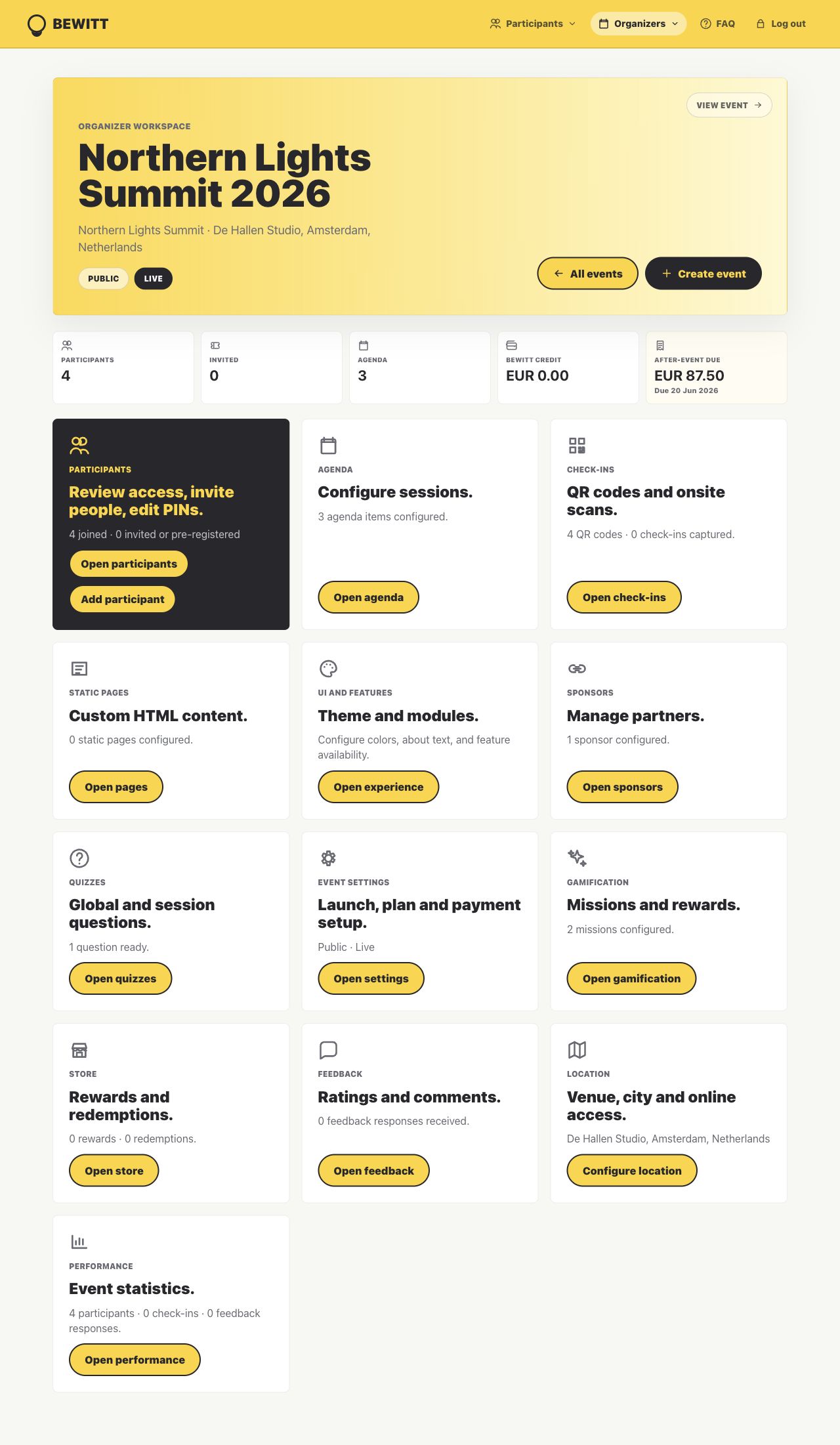
Stova is built for enterprise programs with complex registration, onsite technology, integrations, and reporting. Bewitt starts with the organizer workflow: signups, agenda edits, speaker details, participant access, check-in, feedback, and reporting.
| Feature | Stova | Bewitt |
|---|---|---|
| Event registration | Supports complex registration requirements, workflows, invitation lists, badges, travel, hotels, certificates, and reporting. | Registration stays close to the event page, participant access, agenda, check-in, engagement, and reporting. |
| Event website | Provides event websites, email campaigns, mobile-responsive registration, virtual environments, and branded event assets. | A branded event page sits in the same workspace as participants, speakers, sessions, and event-day settings. |
| Agenda management | Strong fit for multi-day events, simultaneous sessions, complex tracks, agenda builders, and workflow automation. | Build sessions, locations, signups, check-ins, feedback, and speaker details without rebuilding the schedule elsewhere. |
| Speaker profiles | Supports speaker and session management, including speaker resource workflows and attendee-facing speaker bios. | Speaker profiles can stay tied to agenda sessions, event content, and organizer updates. |
| Participant management | Useful for enterprise attendee profiles, registration records, CRM integrations, travel data, permissions, and portfolio reporting. | Import, invite, manage access, and keep participant records close to registration and event-day actions. |
| Event check-in | Supports onsite check-in, badge printing, session tracking, RFID, QR, NFC, facial recognition, and enterprise onsite workflows. | QR check-ins can support event entry, sessions, sponsors, missions, and other onsite moments. |
| Event communications | Supports email marketing campaigns, attendee messages, reminders, and communications across event portfolios. | Organizer communication can sit beside participant access, agenda changes, and event setup. |
| Networking | Supports attendee networking through mobile event apps, smart badges, messaging, and engagement features. | Networking is available when the event needs it, without making networking the only center of the workspace. |
| Polls | Interactive tools and feedback workflows can support attendee engagement and event measurement. | Quizzes, feedback, ratings, and engagement tools can be used when they serve the room. |
| Q&A | Q&A and interaction can be part of Stova’s virtual, hybrid, mobile app, and engagement toolset. | Useful interaction can sit beside agenda, check-in, feedback, and reporting in the same event workspace. |
| Hybrid events | Supports in-person, virtual, and hybrid events with integrated planning, delivery, streaming, mobile app, and analytics tools. | Hybrid settings can stay connected to agenda, participant access, live streams, and organizer controls. |
| Virtual events | Supports virtual event delivery with live and on-demand streaming, branded lobbies, moderation, and virtual analytics. | Supports online access where the event needs it, while keeping the organizer workflow practical. |
| Branding | Offers deep branding for registration, event websites, mobile apps, virtual environments, emails, and onsite materials. | Start with a Bewitt subdomain or connect a custom domain when the event needs to feel properly yours. |
| Event engagement | Supports mobile apps, smart badges, messaging, sponsors, exhibitors, polls, feedback, and onsite or virtual engagement. | Use missions, quizzes, points, rewards, feedback, ratings, and networking when they fit the event. |
| Analytics | Strong fit for portfolio reporting, attendee journey data, session tracking, ROI measurement, and enterprise dashboards. | Track attendance, check-ins, activity, feedback, and reporting signals without exporting every piece first. |
| Team collaboration | Designed for large teams, multiple departments, permissions, enterprise workflows, integrations, and managed services. | A lighter workspace for teams that need shared event operations without a heavy enterprise rollout. |
| Transparent pricing | Pricing depends on organizational requirements, event complexity, selected services, and enterprise platform scope. | €54.00 base fee + €5.50 per event day + €0.55 per participant, up to 500 participants self-service. |
| Self-service setup | Can support DIY or enterprise registration, often fitting organizations with complex workflows and dedicated event teams. | Designed so organizers can get an event online quickly and keep setup understandable. |
| Best fit | Enterprise conferences, large event portfolios, complex registration programs, and professional event teams. | Conferences, business events, internal events, community events, and hybrid formats that need one practical event workspace. |
Stova: enterprise platform
Stova is enterprise-focused, designed for large organizations, complex event programs, advanced workflows, integrations, onsite technology, virtual and hybrid delivery, and professional event teams.
Bewitt: self-service event platform
Bewitt helps organizers get events online quickly by centralizing registrations, agendas, speakers, participants, communications, check-in, engagement, feedback, and reporting.
Pricing approach
Enterprise complexity, or a price you can calculate early?
Stova pricing depends on organizational requirements, event complexity, selected services, and enterprise platform scope. Bewitt uses transparent event-based pricing: €54.00 base fee + €5.50 per event day + €0.55 per participant, with self-service setup up to 500 participants.
€54.00 + €5.50 + €55.00
€54.00 + €11.00 + €137.50
€54.00 + €16.50 + €275.00
Choose Stova if...
- You manage enterprise event portfolios.
- You require extensive organizational workflows.
- You have dedicated event teams.
Choose Bewitt if...
- You need a complete event management workspace.
- You want predictable costs.
- You want an easy setup process.
- You manage conferences, business events, internal events, or hybrid events.
Best fit by event type
Match the platform to the weight of the event.
Some events need enterprise machinery, bespoke workflows, and a large operations layer. Others need a dependable place to run registration, agenda changes, access, check-in, engagement, and reporting without making the team chase tabs all week.
Enterprise Conferences
Stova may fit complex enterprise conferences with many teams, integrations, workflows, and onsite needs. Bewitt fits when organizers want the core event workflow without enterprise rollout weight.
Business Events
Stova can support large business event portfolios. Bewitt is useful when business event teams need a practical workspace for registration, agendas, speakers, participants, check-in, and reporting.
Internal Events
Stova can work for formal internal programs with enterprise controls. Bewitt keeps setup lighter when teams need signups, agenda, access, check-in, and feedback together.
Community Events
Stova may be more platform than a community event needs. Bewitt helps communities manage participants, check-ins, and engagement without a long setup cycle.
Hybrid Events
Stova supports virtual, hybrid, and in-person events. Bewitt keeps hybrid access connected to registration, agenda, check-in, and participant tools.
Multi-Day Events
Stova can support complex multi-day tracks and enterprise reporting. Bewitt helps organizers keep sessions, speakers, participants, and check-ins in one place.
FAQ
Questions organizers ask when comparing Bewitt and Stova.
Is Bewitt a Stova alternative?
Yes. Bewitt is a Stova alternative for organizers who want registration, agendas, speakers, participants, check-in, engagement, hybrid access, and reporting in a practical event workspace.
What are the differences between Bewitt and Stova?
Stova is enterprise-focused, with tools for large organizations, complex registration, event portfolios, integrations, virtual and hybrid delivery, onsite technology, and managed services. Bewitt focuses on simpler self-service event operations with transparent event-based pricing.
Does Bewitt support hybrid events?
Yes. Bewitt supports hybrid event needs such as online access and live-stream settings while keeping the agenda, participants, and event setup connected.
Does Bewitt support speaker management?
Yes. Bewitt supports speaker profiles and keeps them connected to agenda sessions, event content, participant-facing pages, and organizer workflows.
How is Bewitt priced?
Bewitt uses transparent event-based pricing: €54.00 base fee, €5.50 per event day, and €0.55 per participant. Self-service events support up to 500 participants, with custom quotes available for larger events.
Which platform is easier to set up?
Bewitt is designed for fast self-service setup. Stova may fit teams that need enterprise configuration, integrations, complex workflows, and professional event operations support.
Looking for an alternative to Stova?
Manage registrations, agendas, speakers, participants, and engagement from a single platform.
Bewitt in practice
The comparison is not just feature names. It is where the event work lives.
Bewitt is strongest when organizers need registrations, agenda changes, access, check-in, feedback, and reporting tied to the same event instead of spread across a ticketing tool, a spreadsheet, and a last-minute message thread.
Before the event
Registration pages, participant imports, access rules, agenda setup, speakers, sponsors, and branding start from one event record.
On event day
Participant lookup, QR check-ins, agenda changes, room/session activity, and practical updates stay close to the same workspace.
Afterwards
Attendance, feedback, ratings, engagement, and reporting signals are available without rebuilding the recap from scattered exports.