
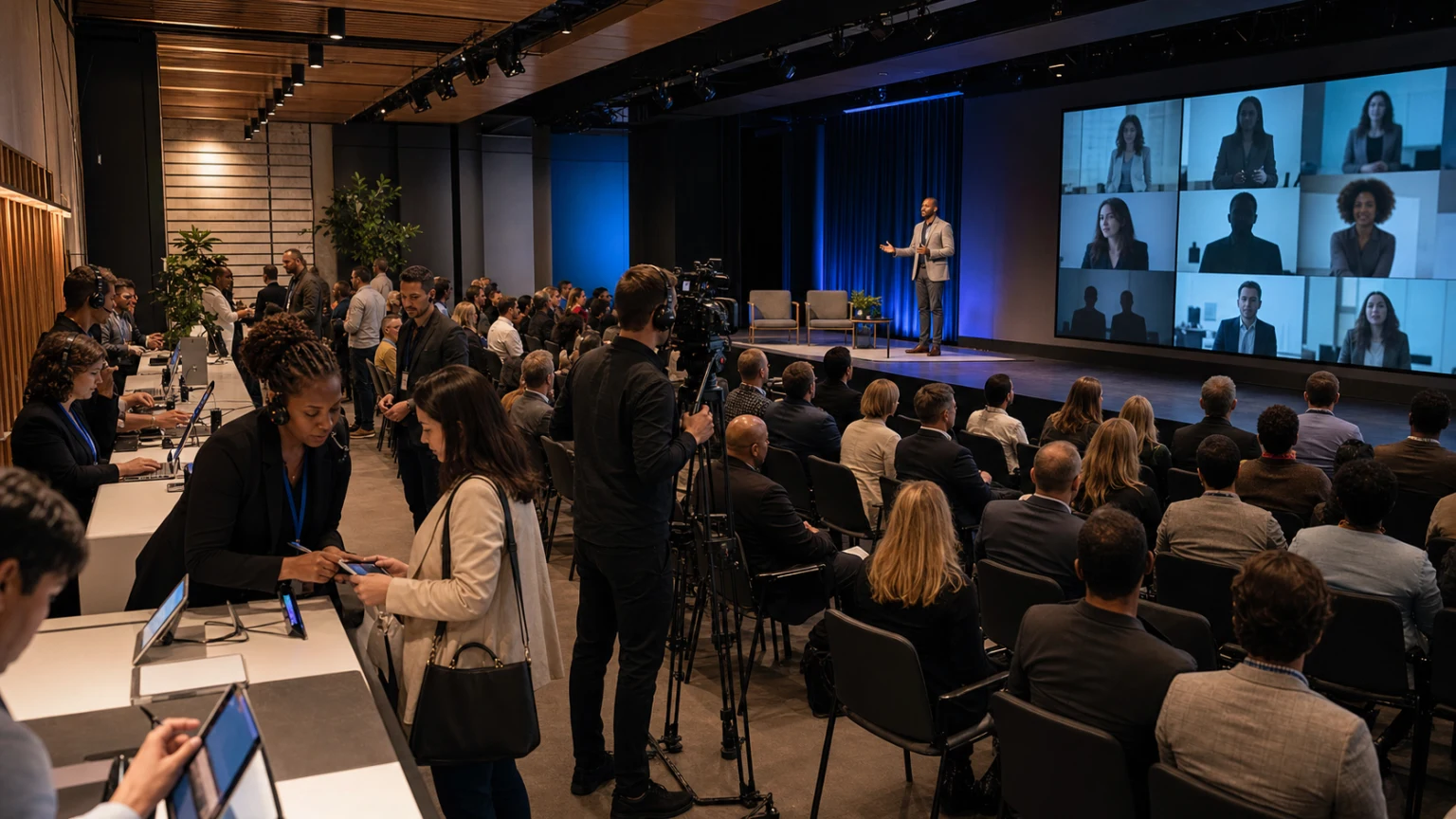
Event venues are no longer just hosting a room program and adding a stream on the side.
More events now combine live attendance, recorded content, remote viewing, and interactive audience moments in the same experience. The lines between formats are getting thinner, and that changes how venues have to operate.
This is not only a programming shift. It is an operations shift.
When content formats blur together, the biggest risk is not technical ambition. It is running three event experiences with one venue workflow.
If a venue is hosting live sessions, on-demand access, and interactive participation at once, the question is simple: what has to change behind the scenes so the event still feels coherent?
Why format blending matters for venues now
Audience expectations are changing.
People are increasingly used to moving between live, recorded, and interactive content in their everyday media use. That expectation does not disappear when they attend an event.
For venues, that means the old split between “in-person event” and “virtual add-on” is becoming less useful. A single event may now include:
- live stage sessions for people in the room
- simultaneous streams for remote attendees
- recorded sessions published later
- interactive elements such as live questions, polls, or digital participation
- different access rules for different audience groups
Each of those formats sounds manageable on its own. Together, they create coordination problems if the venue and organizer have not agreed on the operating model early.
The real challenge is not content, it is workflow
Multi-format events often fail in ordinary places.
The stream starts late because the room turnover ran over. The on-demand version is missing session context. Staff do not know which audience questions get priority. A sponsor element appears in the room but not in the remote experience. The agenda says one thing, the signage says another, and the digital audience sees a third version.
None of this is usually caused by a lack of effort.
It happens because live delivery, recording, publishing, and audience interaction are treated as separate projects.
If the venue team, production team, and organizer are each working from a different version of the event, format complexity turns into participant confusion very quickly.
Venues need to define the event in formats, not just rooms
Room setup is still important. It is just no longer enough.
Before the event, venues should push for a simple content map that answers:
- which sessions are live only
- which sessions are streamed live
- which sessions will be available on-demand later
- which sessions include audience interaction
- which audience groups can access each format
This helps venues plan more realistically across staffing, timing, access, equipment, and support.
Without that map, teams tend to discover format requirements too late. That usually shows up as rushed cabling, improvised moderation, delayed publishing, or unclear participant communications.
Agenda operations get harder when one session has several versions
A session used to be a scheduled moment in a room.
Now it may also be:
- a live stream
- a replay asset
- a moderated chat window
- a sponsor exposure slot
- a source for follow-up clips or gated content
That means session operations need tighter ownership.
For each agenda item, someone should be responsible for:
- start and end timing
- in-room readiness
- stream readiness
- recording confirmation
- interactive moderation
- post-session publishing handoff
If those jobs are spread loosely across teams, delays are almost guaranteed.
Access rules need to stay believable
Mixed-format events often create access confusion.
Some participants can attend in person but not view premium replays. Some remote attendees can watch only selected sessions. Some sponsors or speakers need broader access than general registrants. Some recordings may need to stay unpublished until approval is complete.
For venues, this matters operationally even if the organizer owns registration policy. Staff still need to understand the access model well enough to avoid giving conflicting answers.
A few practical checks help:
- confirm which audience types exist
- document what each group can access
- align front-of-house and digital support scripts
- set a clear escalation path for exceptions
That is especially important when attendees move between physical and digital participation during the same event.
Interactive formats need moderation, not just technology
Venues sometimes focus heavily on the technical side of interaction and too lightly on the human side.
Polling, audience questions, and other participatory moments are not self-managing. Someone has to decide:
- how questions are collected
- who reviews them
- how they reach the stage
- whether in-room and remote audiences are handled equally
- what happens when participation runs over time
That is an operating decision, not just a platform decision.
If no one owns moderation, interaction becomes unpredictable. If too many people own it, nothing moves cleanly.
Recording and on-demand publishing should be planned before the event starts
On-demand content is often treated like a post-event bonus. In reality, it should be treated like part of the event product.
For venues, that means asking practical questions early:
- Which sessions must be recorded?
- What quality standard is expected?
- Who approves the final asset?
- How quickly does the recording need to be published?
- What content should not be reused without review?
These decisions affect room setup, speaker prep, staffing, and timing.
If a venue knows a keynote must become a polished on-demand asset within hours, that may change camera planning, stage movement, audio checks, and file handoff expectations.
Sponsors will care about format consistency
Multi-format content changes sponsor delivery too.
A sponsor that appears in-room may also expect visibility in the stream, replay, or interactive layer. If those placements are inconsistent, value becomes harder to explain later.
Venues do not need to own sponsor strategy, but they do need clarity on what has been promised operationally.
That may include:
- stage mentions
- screen placement
- holding slides in streamed sessions
- branding within digital content moments
- presence in interactive segments
When live and digital delivery diverge, sponsors often notice faster than attendees do.
Staffing models need to reflect the actual experience being delivered
A multi-format event usually needs more than a room crew and a registration desk.
Even relatively simple setups can require distinct responsibilities across:
- front-of-house operations
- speaker handling
- stream monitoring
- interactive moderation
- recording oversight
- publishing coordination
- participant support for access issues
That does not always mean hiring a large team. It does mean assigning clear ownership.
One of the fastest ways to create event-day friction is to assume digital delivery tasks will somehow be absorbed by people who are already busy running the physical event.
What venues should lock down before event week
If a venue is hosting mixed-format content, a short pre-event review can prevent a lot of avoidable confusion.
A practical checklist
- agree which sessions are live, streamed, recorded, interactive, or some combination
- confirm access rules for each audience type
- assign owners for room delivery, stream delivery, moderation, and publishing handoff
- align the agenda across venue, organizer, signage, and participant-facing channels
- document sponsor obligations tied to each format
- set escalation rules for late changes, missing assets, or access disputes
- decide how staff will answer common participant questions
That review does not need to be elaborate. It needs to be specific enough that staff are not improvising under pressure.
What this means for venue strategy
Venues that support multi-format events well are likely to stand out for a simple reason: organizers increasingly need places that can handle content complexity without turning the event into a coordination problem.
The value is not only in cameras, connectivity, or screens.
It is in repeatable operating discipline:
- clear format planning
- believable access logic
- consistent agenda handling
- strong handoffs between live and digital teams
- fewer participant surprises
As content formats continue to blur, venues do not need to become media companies. But they do need to think more like content operations partners.
Final thought
The shift toward live, on-demand, and interactive experiences is not a passing event gimmick. It reflects a broader change in how audiences expect to consume content.
For venues, the practical takeaway is straightforward: do not treat multi-format delivery as an add-on layered onto a room plan.
Treat it as an event model with its own workflows, staffing needs, access rules, and failure points.
That is usually the difference between a venue that merely hosts the event and one that helps the event actually work.