
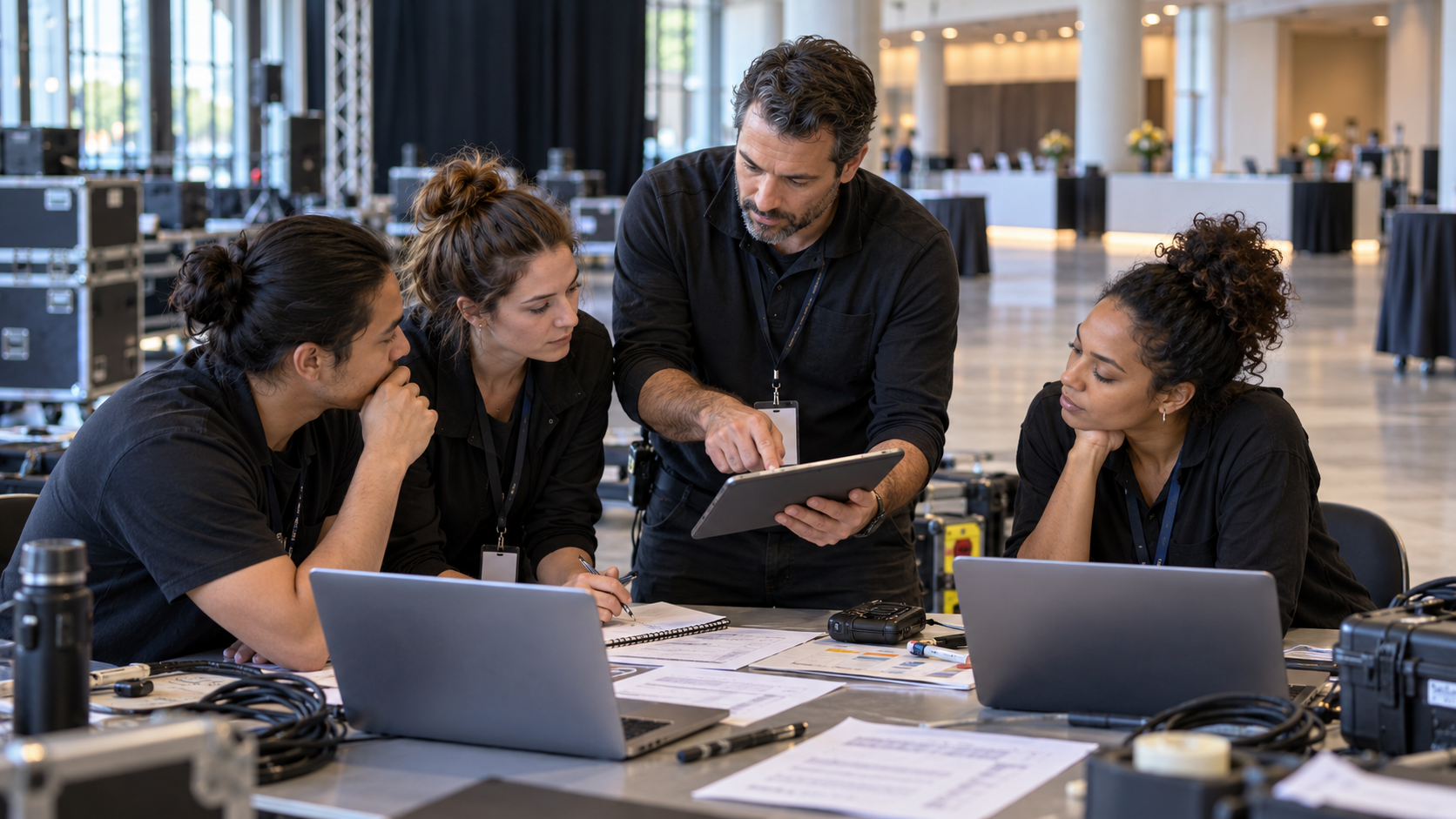
Event tech training often breaks at the same point: one strong operator knows the system, everyone else learns informally, and knowledge disappears the moment schedules tighten or staff change.
That is why train-the-trainer programs matter. They help event teams turn working knowledge into repeatable operational capability.
The public signal behind this topic is useful but narrow: High MSS Event Tech Academy has reportedly graduated more than 60 students, with the stated aim of building a new generation of event technology professionals.
That is enough to support a practical discussion about how event organisations, agencies, venues, and internal operations teams can build a trainer pipeline of their own.
If event tech knowledge only lives with the people who were there last time, the team does not have a training system. It has memory risk.
Why this matters for event operations
Most event teams do not struggle because nobody is willing to learn. They struggle because learning is rushed, uneven, and too dependent on a few experienced people.
That creates predictable problems:
- new staff learn different versions of the same workflow
- on-site teams rely on workarounds instead of agreed process
- basic platform tasks still need escalation
- temporary staff can do clicks, but not decisions
- small mistakes repeat across events
- training has to start again every season
A train-the-trainer model helps reduce that fragility. Instead of teaching every person from scratch each time, you develop a smaller group who can teach others consistently.
What the public signal tells us, and what it does not
From the source idea provided, the confirmed signal is limited but relevant: an event tech academy has graduated over 60 learners and is being framed as part of talent development in event technology.
What this does not tell us on its own is:
- the curriculum structure
- how trainees were assessed
- which event systems were covered
- how many graduates moved into live roles
- whether trainers were internal, external, or mixed
- which teaching methods produced the best operational outcomes
That distinction matters. We can responsibly use the signal to discuss training strategy, without claiming details the source does not confirm.
A growing talent pipeline is encouraging. It does not remove the need for structured training design inside the teams that will actually run events.
What a train-the-trainer program should actually do
In event operations, a trainer is not just someone who knows the platform. A useful trainer can explain the workflow, show the task, spot common errors, and teach people what to do when conditions change.
That means a solid program should prepare trainers to do four things well:
- teach core platform actions clearly
- connect those actions to real event workflows
- handle exceptions and edge cases
- check whether learners can perform under time pressure
If your program only produces slide presenters, not operational teachers, it will not hold up on-site.
Start with the workflows, not the software menu
One common mistake is to structure training around every feature in a tool. That feels thorough, but it is rarely how event teams work.
People need training in the order they experience the event.
For example, a trainer pathway is usually stronger when it follows operational sequences such as:
- participant setup and registration review
- approval or status handling
- agenda and session preparation
- communications and update handling
- badge and check-in readiness
- live attendance capture and issue resolution
- reporting and post-event closeout
This keeps the training grounded in what staff actually need to do, not what the product happens to contain.
Choose the right trainers
Your best system user is not automatically your best trainer.
When selecting trainers, look for people who combine platform confidence with patience, process discipline, and operational judgement.
A good trainer candidate usually shows signs like these:
- they explain steps consistently
- they stay calm when learners get stuck
- they understand why a workflow exists, not just where to click
- they can distinguish between user error and process design problems
- they document changes instead of teaching from memory alone
If possible, choose trainers from different operational contexts, such as registration, programme delivery, attendee support, or on-site management. That gives the program broader credibility and better examples.
Build the curriculum in three layers
1. Core platform competence
This is the baseline. Trainers must be able to use the relevant event tools accurately and confidently.
That includes routine tasks, common corrections, and the most likely user mistakes.
2. Workflow understanding
Trainers also need to understand how platform actions affect other parts of the event.
For example, a participant change may affect check-in, reporting, communications, or session access. A trainer should be able to teach those downstream effects clearly.
3. Teaching capability
This layer is often missed. Trainers need simple teaching skills:
- how to break a task into steps
- how to demonstrate without rushing
- how to ask learners to repeat a task
- how to check understanding
- how to correct errors without creating confusion
Without this layer, the program produces subject matter experts, not trainers.
Use real event scenarios during training
Event tech training becomes more useful when it is built around realistic situations rather than ideal demos.
That might include scenarios such as:
- a participant record needs a last-minute correction
- a session is full and access rules need to be checked
- an attendee was registered but does not appear as expected
- staff need to confirm attendance quickly during a live session change
- a report is requested in a different format under time pressure
These exercises do two things. They prepare trainers for what learners will face, and they reveal whether your own workflows are teachable in the first place.
Create trainer materials that survive turnover
If the program depends on one person's style, it will weaken as soon as staffing changes.
Every trainer should work from the same practical materials:
- step-by-step guides for key workflows
- short scenario exercises
- lists of common mistakes and fixes
- clear definitions of which fields or actions are organiser-controlled
- version-controlled notes when processes change
Keep these documents short enough to use during live work. Training material that only works in a classroom is not enough for event delivery.
Set a certification standard, even if it is internal
Not every organisation needs a formal credential. But every train-the-trainer program needs a clear standard for readiness.
A trainer should not be approved just because they attended the sessions.
A practical internal standard might require them to:
- complete the workflow training
- demonstrate key tasks accurately
- teach a short section to peers
- handle a scenario-based problem
- use the approved documentation correctly
This creates a visible quality threshold. It also gives managers a better basis for assigning trainers to real events.
Plan for refresh training, not one-time completion
Event operations change constantly. Agendas shift, policies evolve, staff rotate, and tools are updated.
That means trainer development cannot be treated as a one-off project.
Useful refresh structures include:
- pre-season trainer calibration sessions
- brief update modules when workflows change
- post-event reviews of recurring support issues
- peer observation between trainers
- periodic reassessment for high-risk workflows
The goal is consistency over time, not a certificate that quietly goes stale.
Where teams often get this wrong
They train too broadly
Trying to teach everything at once usually lowers retention. Start with the workflows that most affect live delivery.
They confuse product knowledge with teaching ability
A strong operator may still need coaching on how to teach clearly and consistently.
They skip practice under pressure
If trainers only learn in calm environments, they may struggle to support others during real event conditions.
They fail to define ownership
Trainers need to know what they are allowed to teach, what requires escalation, and which process changes must be approved centrally.
They do not measure whether training changed performance
If you only track attendance in training sessions, you do not know whether the program improved operations.
How to measure whether the program is working
You do not need a complex framework to start. A few operational indicators are enough.
Look for movement in areas like:
- fewer repeated user errors
- faster onboarding time for new staff
- fewer escalations for routine tasks
- more consistent process use across events
- less dependence on one or two expert users
- cleaner handover between planning and on-site teams
If these are not improving, the issue may be the training design, the workflow design, or both.
A simple rollout model for event teams
If you are building a program from scratch, keep the first version small.
- Identify the 5 to 8 workflows that matter most operationally.
- Select a small trainer cohort with both system and communication strengths.
- Build short, standardised materials for those workflows.
- Run scenario-based practice, not just demonstrations.
- Assess trainers through observed teaching and task completion.
- Deploy them on one event cycle and review what broke.
- Refine the program before scaling it wider.
This approach is slower than ad hoc training at the start, but far more stable once event volume grows.
What this means for event teams
A growing number of event tech learners is a positive signal for the industry. But hiring or enrolling learners is only part of the answer.
Event teams still need a reliable way to turn knowledge into repeatable delivery.
That is what a train-the-trainer program is really for: not education as a side project, but operational resilience. When more people can teach the work correctly, the team becomes less dependent, more scalable, and better prepared for the pressure of live events.
In practice, the best program is usually the one that stays close to real workflows, measures readiness honestly, and treats training as part of event operations, not separate from it.