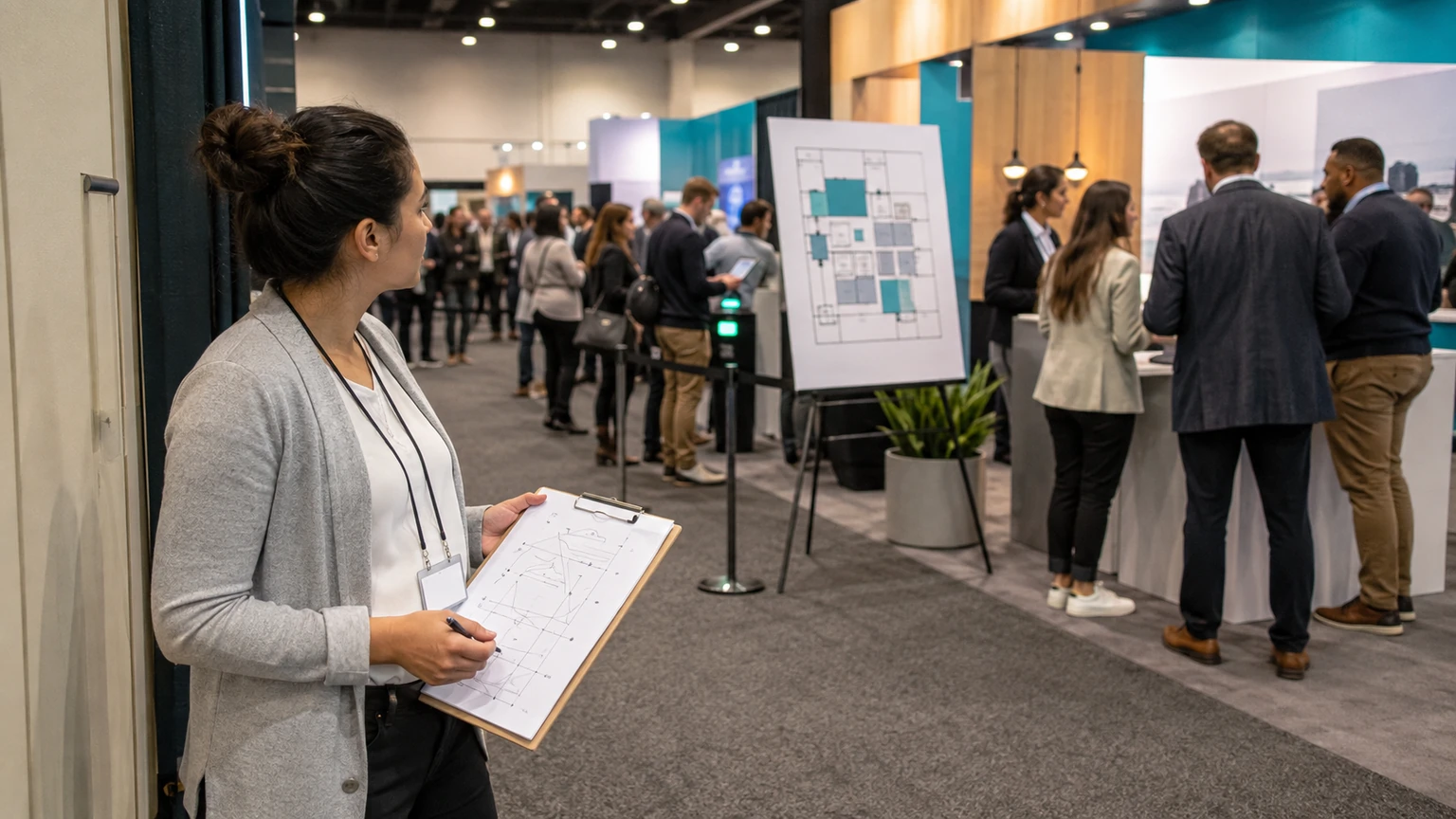

AI exhibition agents are moving from concept to live event deployment.
Recent industry coverage reports that Alibaba's Accio launched an AI "Exhibition Agent" across leading trade shows in the UK and Europe. That matters because it turns AI for exhibitions into an operational question, not just a future-facing idea.
For organizers, exhibitors, and venue teams, the real issue is not whether AI sounds impressive. It is whether an AI layer can help people get answers, find relevant exhibitors, and move through the show more confidently without creating confusion for staff.
An AI exhibition agent is most useful when it reduces simple friction at scale: finding the right stand, answering repeat questions, and helping visitors decide what to do next.
Why this matters
Large exhibitions create a familiar on-site problem. Visitors arrive with too many choices and too little time.
They need to know:
- which exhibitors are relevant
- where those exhibitors are located
- which sessions are worth attending
- what is happening next
- how to navigate the venue efficiently
- where to get help when plans change
Most of these questions are predictable. They also arrive in bursts, often when staff are busiest.
That is why AI exhibition agents are getting attention. In theory, they can absorb repetitive guidance work and make discovery easier. In practice, they only help if the answers are accurate, timely, and clearly limited to what the event can actually support.
What an AI exhibition agent can realistically help with
Based on the way exhibition teams already operate, the strongest use cases are usually the simplest ones.
1. Exhibitor and product discovery
Visitors often know the problem they want to solve, but not which stand to visit.
An AI agent may help translate broad intent into a smaller shortlist, for example by helping a visitor narrow options by category, sector, or stated need.
That is especially useful at large B2B trade shows where hundreds of exhibitors may fit loosely, but only a smaller number fit well.
2. Wayfinding and route confidence
Maps alone do not always solve navigation under time pressure.
If an AI assistant can point someone to a hall, stand area, or service point in plain language, it may reduce directional questions at information desks and on the show floor.
Even a small improvement here matters because visitors often abandon plans when navigation feels slow or uncertain.
3. Answering repeat event questions
Event teams know the pattern. The same questions return all day:
- where is registration
- when does a session start
- which entrance should I use
- where can I find a specific exhibitor
- what time does the expo close
- where is the networking area or help desk
An AI agent may be able to handle part of this repetitive load, giving staff more time for exceptions, VIP support, and operational issues that need a human response.
4. Agenda and next-step guidance
Visitors do not always need a full schedule. They often need the next sensible action.
Useful AI support may include helping someone identify a relevant session, a nearby exhibitor, or a practical route through the day based on the time available.
The value is usually not in showing more information. It is in helping people act on the information already available.
Where event teams should stay cautious
The risk with AI on site is not only technical failure. It is misplaced trust.
If attendees assume the agent always knows best, weak or outdated answers can create new friction quickly.
Common risk areas
- incorrect exhibitor information
- outdated session times or room changes
- poor wayfinding instructions in complex venues
- overconfident answers to questions that should go to staff
- mismatched recommendations that frustrate visitors
- unclear handling of visitor data or conversation logs
This is why AI exhibition agents should be treated like a live operational surface, not a marketing add-on.
If the event would not trust a printed sign with outdated information, it should not trust an AI experience with the same problem.
Start with the operational job, not the AI label
Before deploying any AI agent, event teams should define the job clearly.
Good starting questions include:
- what attendee problem are we trying to reduce
- which questions currently overload staff or exhibitors
- what information source will the agent rely on
- who owns updates during live show hours
- when should the agent hand the user to a human team member
That matters because many exhibition questions look similar, but have different operational consequences.
For example, helping someone find a stand is one kind of task. Advising them on schedule changes, access rules, or service exceptions is another. The second requires tighter control.
Build around approved event data
An exhibition agent is only as useful as the event data behind it.
That means organizers should work from approved, current sources for:
- exhibitor names and categories
- stand locations
- agenda and session timing
- venue service points
- opening hours
- attendee-facing policies and instructions
If these inputs are scattered across spreadsheets, PDFs, inboxes, and last-minute edits, the AI layer may simply expose data inconsistency faster.
In other words, an AI agent does not remove the need for event operations discipline. It makes that discipline more visible.
Plan clear handoff points to human staff
The best on-site service models are not fully automated. They are well routed.
An AI exhibition agent should have obvious boundaries.
Questions that often need human handoff
- badge or registration issues
- VIP or hosted buyer support
- accessibility and assistance requests
- complaints or service recovery
- sponsor or exhibitor disputes
- safety, medical, or venue incidents
If users cannot tell when they should stop asking the AI and speak to staff, service quality suffers.
That is not an AI problem alone. It is a service design problem.
Think about exhibitor impact, not just attendee novelty
For exhibitors, the promise of an AI exhibition agent is not only convenience. It is better matching.
If a visitor gets directed toward more relevant stands, exhibitor conversations may improve in quality, not just volume.
But that only works if the recommendation logic reflects how exhibitors are actually categorized and described.
Event teams should therefore check whether exhibitor listings are:
- clear enough for a visitor to understand quickly
- structured consistently across categories
- specific enough to separate similar suppliers
- updated to reflect what the exhibitor is actually presenting
If exhibitor metadata is vague, the AI layer may produce vague discovery as well.
Test it under show-floor conditions
Many digital tools look better in planning than they do in a crowded hall.
Before relying on an AI exhibition agent, teams should test practical conditions:
- short, rushed visitor questions
- misspelled exhibitor names
- multi-part requests
- schedule change scenarios
- peak-time use when staff are busiest
- questions from first-time international visitors
The goal is not perfection. It is to understand failure modes before the public does.
If the AI agent fails, the attendee experience should still remain recoverable within seconds.
A simple rollout approach for event teams
For most organizers, a phased rollout is safer than a broad launch.
Phase 1: Use it for low-risk information
- exhibitor lookup
- stand location guidance
- opening times
- general event information
Phase 2: Add decision support carefully
- category-based exhibitor suggestions
- basic session discovery
- next-step recommendations
Phase 3: Review operational performance
- which questions it handled well
- which questions still went to staff
- where inaccurate answers appeared
- whether exhibitors felt traffic quality improved
This staged approach helps teams learn where the agent is genuinely useful and where human service still carries the experience.
Common mistakes to avoid
- launching without clear ownership of live data updates
- treating the AI agent as a novelty feature instead of a service tool
- letting it answer questions beyond approved event information
- failing to define human escalation paths
- assuming all visitors will trust or use the tool equally
- measuring success only by usage, not by operational outcome
What this means for event teams
The reported launch of an AI exhibition agent at major UK and European trade shows is a useful signal. AI support for exhibition engagement is no longer abstract.
Still, the practical opportunity is narrower than the hype suggests.
For most events, the near-term value is likely to come from helping visitors discover relevant exhibitors, answer routine questions faster, and navigate the venue with less hesitation. That is already meaningful if done well.
But the real work remains operational: trusted data, clear boundaries, staff handoff, and live testing.
Teams that treat AI exhibition agents as part of service design will be in a stronger position than teams that treat them as a headline feature.