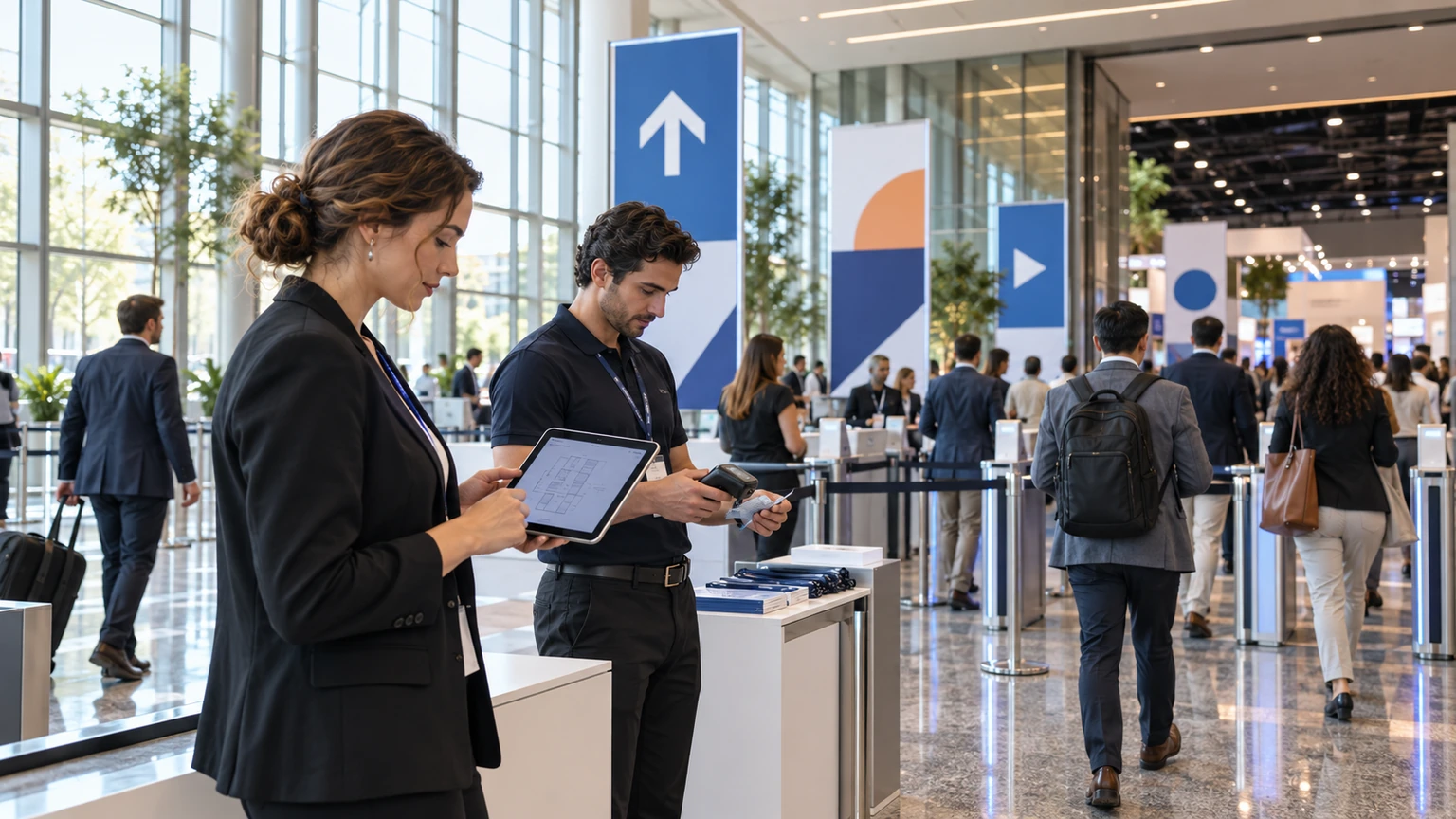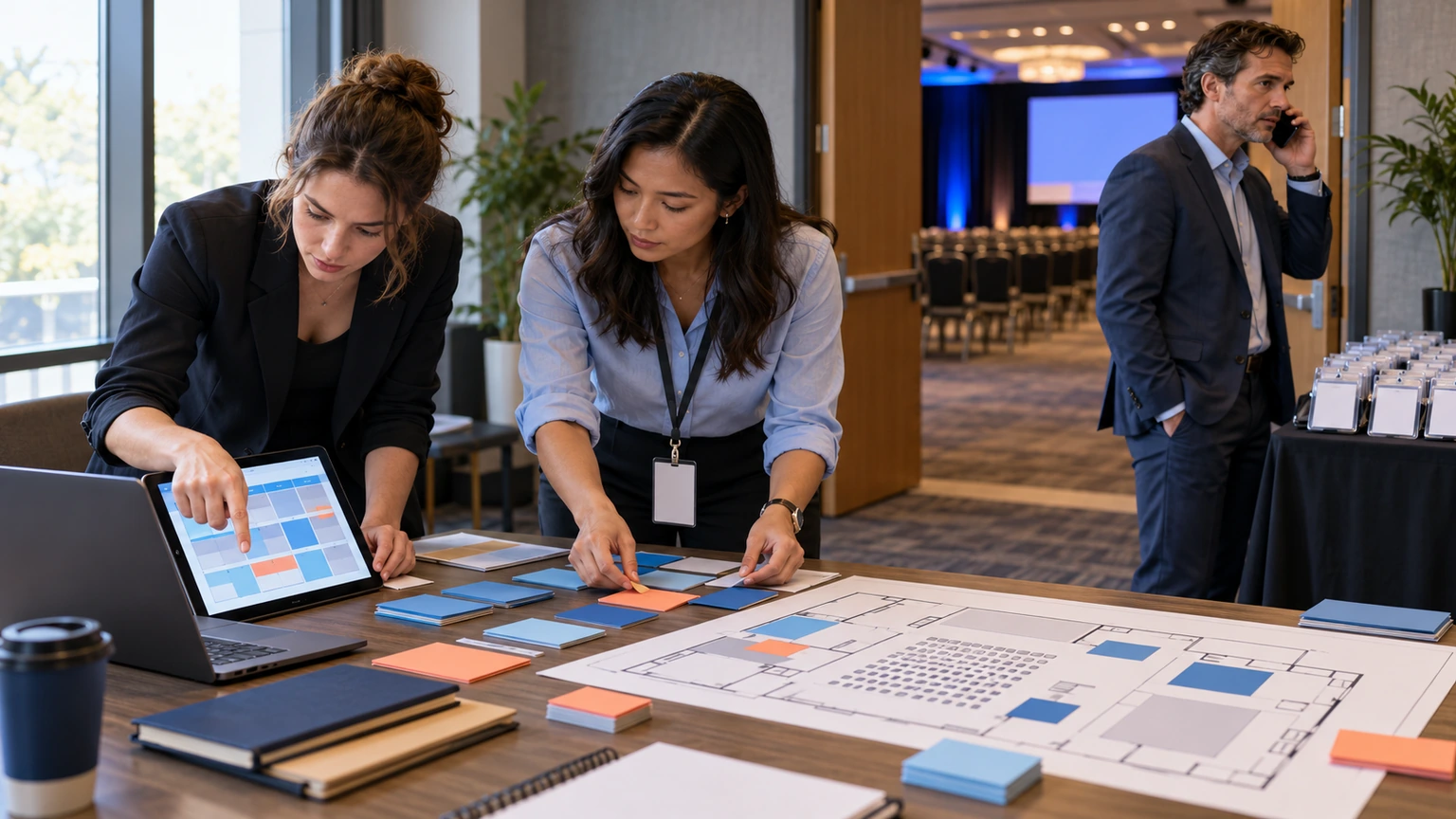
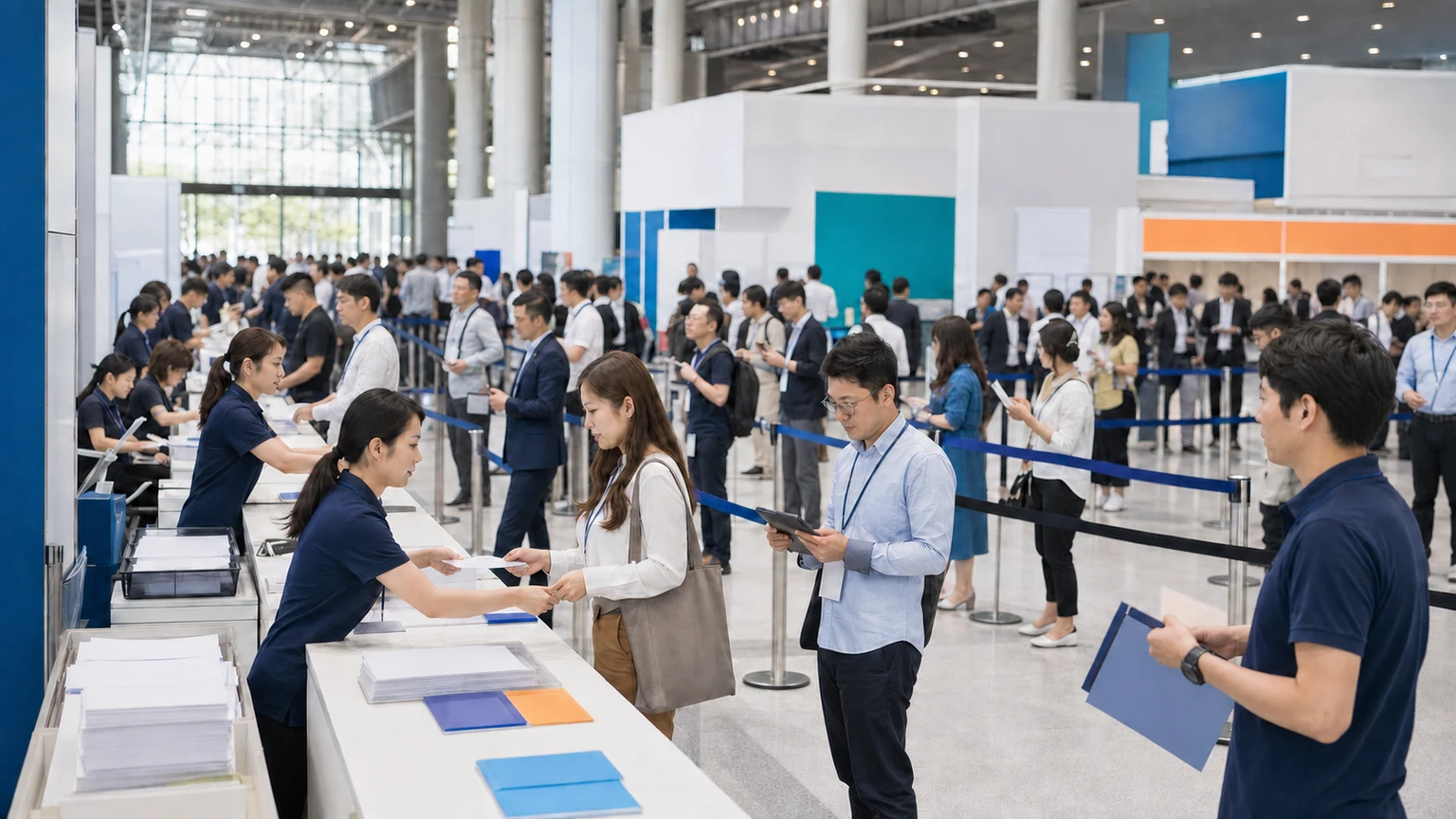
Large expos are getting larger, especially across Asia.
Recent reporting around Fi Asia Indonesia 2026 points to a bigger and more comprehensive edition. That matters beyond one show. It is a useful signal of how exhibition operations are evolving in the region: more scale, more moving parts, and less tolerance for manual coordination.
When an expo expands, the challenge is not only filling more space. It is keeping the attendee, exhibitor, and staff experience coherent as operational complexity rises.
Expo growth is only valuable if the operating model can absorb it.
Why this matters
At a smaller event, teams can often recover from friction with extra staff effort.
At a large expo, that approach becomes expensive and unreliable.
Growth usually increases pressure on:
- registration and badge collection
- entry timing and queue management
- wayfinding across a larger floor
- exhibitor onboarding and support
- meeting coordination
- staff communication
- live issue resolution
- reporting for sponsors, exhibitors, and internal teams
If the event tech stack is treated as a set of disconnected tools, teams often end up with fragmented data, duplicated work, and slower decision-making on site.
What changes when an expo gets bigger
Scale does not just mean more attendees. It changes the operating pattern of the event.
A larger expo often means:
- more entrances or access points
- more varied attendee types
- more complex exhibitor service needs
- more appointments and hosted meetings
- more content running alongside the exhibition
- more reliance on temporary staff and contractors
- more edge cases that need quick handling
That matters because the cost of small inefficiencies rises quickly. A minor check-in delay at a compact event is an inconvenience. At a large expo, it can affect arrivals, staffing, security, and first impressions across the whole day.
Start with operational bottlenecks, not feature lists
When organizers review event tech for a growing expo, the first question should not be What features are available?
It should be Where does the operation break under scale?
Typical pressure points include:
- badge pickup congestion in the first two hours
- slow exhibitor check-in and contractor access
- poor visibility into attendance by time and zone
- difficulty communicating schedule or floor changes
- manual lead and meeting handling
- support teams working from inconsistent information
Once those failure points are clear, technology decisions become more practical.
The best event tech plan for a large expo is usually not the one with the most modules. It is the one that removes the most operational friction.
The core jobs event tech should support
For large-scale trade shows and expos, technology should help teams do a few jobs well.
1. Move people through arrival with less friction
Registration is not only a pre-event admin task. It shapes the first on-site operational peak.
Teams should review whether their setup supports:
- clear pre-event confirmation and arrival guidance
- fast badge collection or validation workflows
- separate handling for attendees, exhibitors, VIPs, and staff
- exception handling when records or access details do not match
- real-time visibility into queue build-up
If arrivals are poorly designed, pressure spreads quickly to front-line staff and venue access teams.
2. Help attendees navigate a larger environment
As expo footprints grow, orientation becomes more important.
Attendees need to understand:
- where key halls and zones are
- how to find relevant exhibitors
- what content is happening nearby
- what has changed since they arrived
- how to move efficiently between meetings and sessions
This is where digital information flows matter. If important event information is slow, unclear, or spread across too many places, the venue floor feels harder to use than it needs to.
3. Give exhibitors cleaner operating support
At larger expos, exhibitor satisfaction depends partly on demand and footfall, but also on how easy the event is to work within.
Operationally, organizers should look at how tech supports:
- pre-show onboarding and information distribution
- schedule clarity for build-up and move-in
- lead capture or contact workflows, where relevant
- meeting visibility and appointment readiness
- faster issue escalation during show days
Exhibitors remember friction. They remember unclear instructions, delayed answers, and manual workarounds just as much as they remember traffic volume.
4. Improve live operational visibility
Large expos are hard to manage when every team sees a different version of the truth.
Operations leaders usually need timely visibility into:
- attendance pace
- peak entry periods
- support demand
- session or feature area load
- schedule changes
- escalated incidents
This does not mean every team needs complex dashboards. It means the right people need reliable information quickly enough to act on it.
Do not separate attendee experience from staff coordination
A common mistake in expo tech planning is treating attendee-facing tools and internal operating workflows as separate conversations.
In practice, they are closely linked.
If attendees receive unclear instructions, support volumes rise.
If floor teams cannot see updated information, inconsistency increases.
If exhibitors do not know where to go or what changed, service desks carry the load.
For larger events, a better approach is to review the whole operational chain:
- what the attendee sees
- what exhibitors receive
- what front-line staff know
- what supervisors can monitor
- how issues are escalated and resolved
That is often where expo tech delivers the most practical value.
A practical framework for scaling expo operations
If an event is growing in size or complexity, organizers can use a simple review structure.
Map the day by operational peaks
Do not evaluate the expo as one smooth journey.
Review pressure by moment:
- pre-arrival communication
- opening rush
- midday circulation
- conference changeovers
- hosted meeting windows
- end-of-day exits
Tech decisions are more useful when tied to real pressure periods.
Define the critical user groups
A large expo rarely has one user journey.
At minimum, teams should consider:
- trade visitors
- buyers or hosted attendees
- exhibitors
- speakers
- operations staff
- venue or contractor teams
If one system or process serves all of them poorly, scale will expose the weakness quickly.
Identify manual repair work
One of the clearest signs that an event has outgrown its current setup is the amount of backstage fixing required.
Look for tasks such as:
- rekeying data between systems
- manually updating team lists
- answering repetitive location questions
- patching meeting schedules by email or message
- resolving badge or access issues without a consistent process
These tasks are easy to normalize. At larger scale, they become a serious operational drag.
Decide what needs to be visible in real time
Not every event metric needs live monitoring.
For expo operations, the useful question is which information helps the team intervene before friction spreads.
That may include:
- entry throughput
- queue buildup
- attendance by period
- meeting no-show patterns
- support ticket volume
- urgent floor updates
Real-time visibility is only valuable if the team knows what action follows.
Common mistakes to avoid
- buying for headline features instead of operational fit
- assuming growth only affects registration volume
- ignoring exhibitor service workflows
- running attendee communications and on-site operations as separate tracks
- leaving exception handling to temporary staff without clear process
- treating post-event reporting as an afterthought
Most expo problems at scale are not caused by one dramatic failure. They come from small disconnected processes that no longer hold up under volume.
What this means for event teams in Asia
As more major exhibitions in Asia expand, organizers will face a familiar question: how do you grow without making the event harder to run?
The answer is rarely more staff alone, and it is not technology for its own sake.
It is using event tech deliberately to support flow, coordination, and timely decision-making across the full event operation.
Fi Asia Indonesia 2026 is one example of the wider direction of travel. Larger, more ambitious expos can create strong commercial opportunity, but only if the operating model scales with them.
For event teams, that means reviewing tech not as a presentation layer, but as part of the way the expo actually works.