
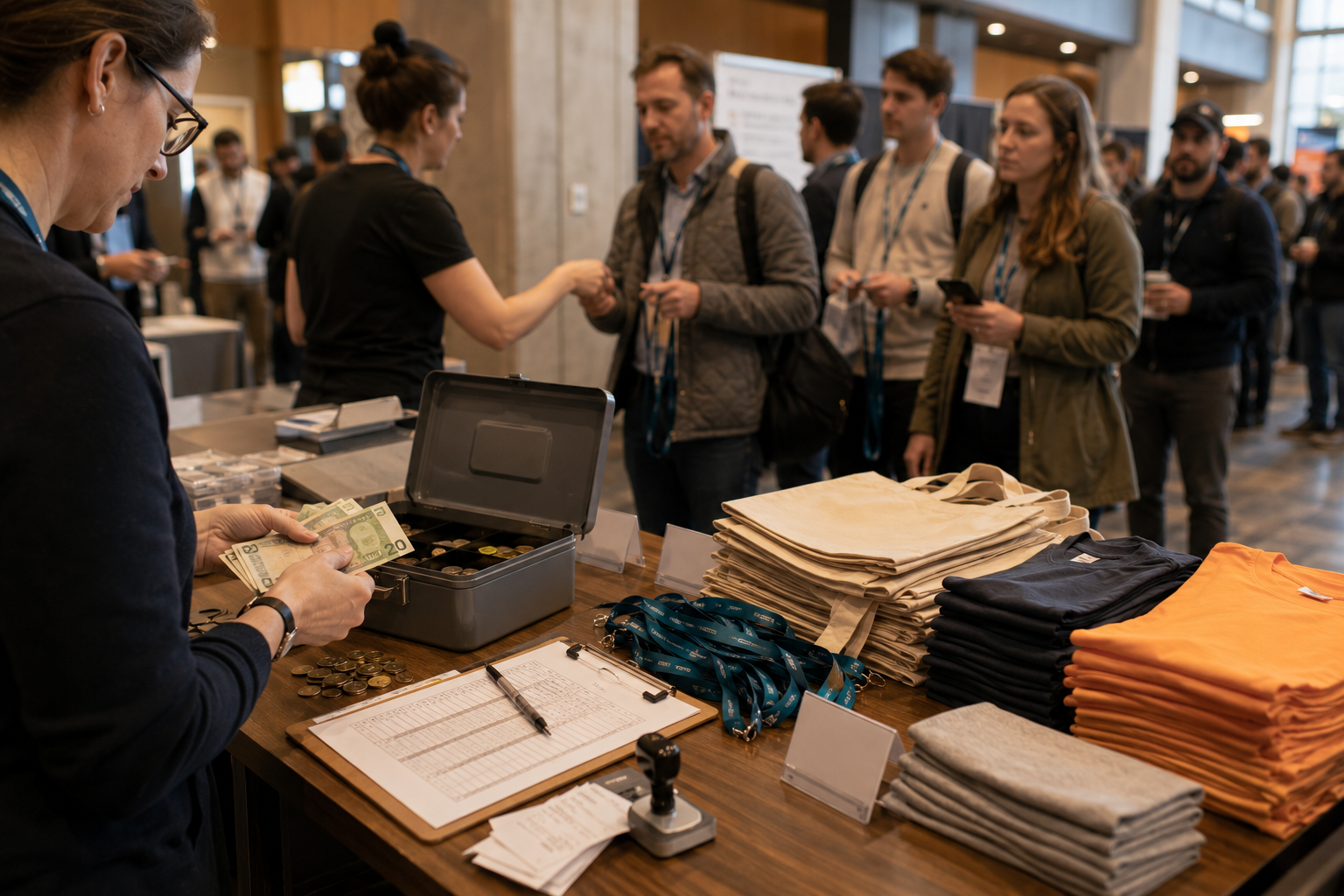
On-site selling is one of the easiest ways to increase revenue during an event.
It’s also one of the fastest ways to create end-of-day arguments.
Because the moment you mix:
- a table
- physical stock
- cash (or “pay me later”)
- points rewards
- and staff rotation
…you’re not running a “store.” You’re running a tiny accounting system with a queue.
The cash table problem isn’t that people are dishonest. It’s that nobody knows what the truth is once the rush starts.
This post is a grounded process you can use for on-site fulfillment when you run a points economy (quizzes, missions, feedback) and you still want to sell real things for real money.
The goal is simple: sell more during the event, without losing track (or trust).
Why on-site revenue breaks down (even at well-run events)
The failure mode is boring and predictable:
- Someone says “I did the quiz, I get the cheaper price.”
- Someone else says “I already redeemed it earlier.”
- A staff member swaps shifts and has no idea what the rules were.
- At 17:30 you have money in a cash box and a pile of sticky notes.
- At 18:00 someone says, “I paid earlier.”
Most organizers don’t need more tools here.
They need a process that survives rush-hour.
The tiny process that prevents arguments
If you sell anything on-site (merch, drink tickets, vouchers, upgrades), treat the table like a checkpoint with rules.
Step 1: Decide what counts as “proof” (and make it points-based)
Pick one acceptable proof per offer. Not three. Not “depends who’s working.”
For a points-driven setup, the cleanest proof is:
- Points: the attendee has enough points to redeem the offer.
And then you decide what the offer actually is:
- Points-only: “Coffee = 50 PTS”
- Cash-only: “Coffee = €2”
- Cash + points option: “Coffee = €2 or €1 + 50 PTS”
The key is consistency: staff should never be asked to judge intent (“they seem like they probably did the mission”).
Step 2: Price items like you have a points economy (because you do)
The mistake is treating points like a cute extra.
If you’re awarding points for quizzes, missions (when gamification is active), or feedback, you’ve created a small event currency. That means you should do a tiny bit of math up front:
- How many points can an attendee realistically earn in a day?
- How many attendees do you expect to participate?
- Which rewards do you want to be “easy wins” vs. “earned”?
This is how you avoid two common outcomes:
- Everything is too cheap in points → you run out of stock early and spend the afternoon saying “sorry.”
- Everything is too expensive in points → nobody redeems, and your missions become “homework.”
Points are only motivating when people believe they can actually turn them into something.
Step 3: Run stock like you mean it
Most on-site drama is just stock uncertainty wearing a customer-service hat.
Before doors open, write down:
- starting stock per item/variant (sizes matter)
- what happens when stock hits zero
- whether you allow “reservations” at all
If you allow reservations, make them explicit:
- how long a reservation lasts (e.g., “until 14:00”)
- what the attendee must show to claim it
- who is allowed to reserve (and how)
If you can’t explain the stock rules in one sentence, you’ll end up negotiating them with every person in line.
Step 4: Separate “points pricing” from “friendly exceptions”
In a points economy, the “discount” is usually just the points option.
That’s good news: it’s consistent, visible, and doesn’t require staff to improvise.
So split your world in two:
- Official options: the cash price and/or points requirement you defined.
- Exceptions: rare, and approved by one organizer (not the table staff in the moment).
This is how you keep the table calm and keep attendees feeling like the rules are fair.
Turning engagement into revenue (without making it weird)
If you already use engagement modules, the clean pattern is:
Do useful event actions → earn points → choose what to spend them on.
Not “do a thing → beg staff for a discount.”
Use quizzes to drive sponsor and content discovery
Quizzes (when enabled) can nudge people toward the parts of the event they tend to skip.
Practical examples:
- “Complete the keynote quiz” → earn points toward coffee vouchers.
- “Complete the sponsor quiz” → earn points toward a sponsor-provided item.
The difference matters: attendees aren’t asking staff to validate a claim. They’re building a points balance they can spend.
Use missions to move people around the floor (when gamification is active)
Missions and points are at their best when they reduce decision fatigue.
Examples that can also support on-site sales:
- “Visit 3 sponsors” → earn points you can spend on an on-site item.
- “Check in to your workshop” → earn points toward an upgrade or merch.
- “Scan a QR at the expo area” (when QR scanning flows are enabled) → earn points toward a limited item.
Keep it adult: do useful things, get a small benefit.
Use feedback as the cleanest value exchange
Feedback is the easiest engagement to justify.
Because it helps you improve, and attendees understand the trade.
Simple and effective:
- “Submit feedback for 2 sessions” → earn points you can spend at the table.
- “Submit overall event feedback” → earn enough points to unlock a points-only item while stock lasts.
Timing matters: ask for feedback while the event is still fresh, not two days later when you have to beg.
How to staff the table so the system doesn’t collapse
The most common mistake is putting your calmest person at the table and hoping vibes will carry the day.
Instead, give staff a script and boundaries.
A simple table script that works
- “What are you buying or redeeming?”
- “Cash price is X. Points option is Y.”
- “Great—please show your points / redemption in your participant area.”
- “Here’s what’s available in your size/variant.”
- “Done—next.”
That’s it. Not “tell me your story.” Not “who told you that.”
One person owns the rules
Pick one organizer as the decision-maker for exceptions.
The table staff should not be forced to negotiate policy while a line watches.
Where Bewitt fits (practically)
Bewitt is built as a practical event workspace: registration, participant access, agenda, check-in, engagement, feedback, payments, branding, and reporting tied to the same event record.
For on-site revenue and redemptions, this matters when you’re using modules like:
- Quizzes, missions, rewards, and a leaderboard (where enabled) to drive participation via points
- Feedback flows to collect ratings while the event is still fresh
- Payments via Stripe Checkout for paid tickets and rewards store payments (where applicable)
Not every event uses every module. The point is that when you do use them, they live in the same event workspace instead of being a pile of links and screenshots at the table.
The simplest version to try next event
If you want a low-risk pilot, do this:
- Pick one item to sell on-site (limited stock helps).
- Pick one way to earn points (quiz, mission, or feedback—when enabled).
- Pick one pricing rule you can say out loud: cash price, points price, or cash+points option.
- Define one proof rule for staff: “points/redeemed in participant area.”
- At the end of the day, review what sold and whether the points economy felt attainable.
You’ll learn more from one clean on-site experiment than from five theoretical pricing discussions.
Revenue during the event is great. Revenue you can explain afterwards is even better.
Want to run this without spreadsheets and sticky notes?
If your current setup is a mix of forms, spreadsheets, manual check-in, and “prove it on your phone,” it’s worth comparing that workflow with Bewitt.
Book a Demo or start an event and test a simple points → rewards → redemption loop with your real agenda and real staff.