AI-powered attractions keep appearing on expo floors, but organisers still need to separate novelty from operational value.
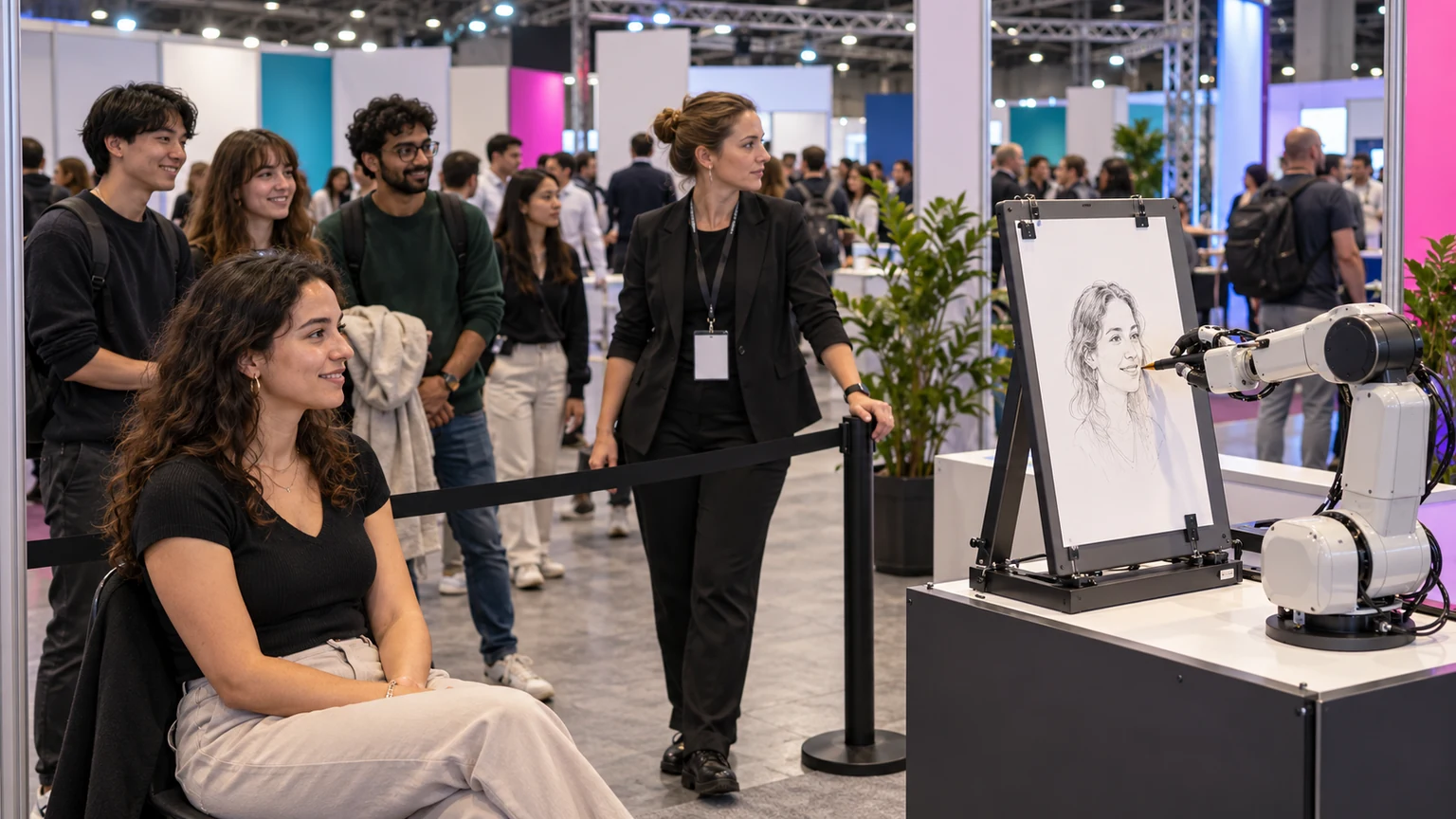
A useful public signal here is that Sweet Robo is bringing ARTI, described as an AI Robot Artist that draws live portraits, to IAAPA Expo 2026.
For organisers, expo managers, and event technology teams, the interesting question is not simply whether live AI art looks memorable. It is whether the experience improves dwell time, traffic quality, sponsor value, or attendee engagement without creating friction on the show floor.
An expo attraction is only as strong as its live operating model. If the queue, staffing, placement, or throughput break down, the experience quickly stops feeling premium.
Why this matters for event operations
Interactive installations often promise attention. What organisers need is attention that can be handled well in a live environment.
Live portrait art is relevant because it sits at the intersection of entertainment, personalisation, and visible audience participation. On a busy expo floor, that can matter for several practical reasons:
- it gives attendees a reason to stop, not just walk past
- it creates visible social proof when people gather and watch
- it offers a take-home output, which can increase perceived value
- it can support sponsor storytelling better than passive signage
- it may create content opportunities for exhibitors and organisers
Those benefits are possible, not automatic. The difference usually comes down to setup, capacity, floor position, and staff handling.
What the public signal tells us, and what it does not
From the source idea provided, the confirmed signal is narrow but useful: Sweet Robo plans to bring ARTI, an AI Robot Artist that draws live portraits, to IAAPA Expo 2026.
That is enough to support a practical discussion about how AI-driven live portrait experiences may fit expo operations.
What this does not confirm on its own is:
- how quickly portraits are produced per attendee
- what queue capacity the experience can handle
- what staffing model is required onsite
- how reliable the setup is during long show days
- whether the output is digital, physical, or both in all use cases
- what measurable ROI exhibitors or organisers have achieved
- how attendees respond outside a demonstration environment
That distinction matters. A showcase appearance signals market direction. It does not remove the need for operational due diligence.
Evidence-aware event teams should treat expo demos as a starting point for evaluation, not as proof that an attraction is ready for every live floor condition.
Why live AI portrait art can work well at expos
The format has some practical strengths that fit trade show behavior.
1. It is easy to understand quickly
Attendees do not need a long explanation to grasp the value exchange. Sit, pose, receive a portrait. On a noisy expo floor, that kind of simple interaction matters.
2. It creates visible participation
Some activations are hard to notice unless attendees are already inside the booth. Portrait creation is more performative. People can see that something is happening, which helps attract secondary footfall.
3. It produces a personal outcome
Personalised outputs often hold attention better than generic branded giveaways. A portrait feels tied to the attendee, not just to the sponsor budget.
4. It can bridge entertainment and brand recall
If the surrounding brand story is handled well, the attraction can do more than entertain. It can support memory, conversation, and post-visit sharing.
Where organisers should be careful
The same features that make a portrait attraction appealing can create operational pressure.
Queueing can overwhelm the space
If demand spikes, a fun activation can turn into a blockage. This is especially risky in narrow aisles, corner booths, or areas near entrances and main crossings.
Organisers should check:
- how many people can wait without spilling into traffic lanes
- whether the exhibitor has a managed queue plan
- what happens when demand exceeds available time
- whether timed slots, ticketing, or soft caps are needed
Throughput may be lower than expected
A live portrait experience feels quick when watching one participant. Over several hours, throughput is shaped by greeting, setup, pose time, generation or drawing time, output handoff, resets, and attendee questions.
If each session takes longer than expected, queue frustration rises fast.
Booth staffing still matters
Even a strong automated or robot-assisted experience usually needs human support around it. Someone may still need to brief attendees, manage lines, explain wait times, resolve exceptions, and connect the activation back to the exhibitor's message.
Not every lead is a qualified lead
High footfall looks good, but organisers and exhibitors should avoid assuming that every participant is commercially useful. Some attractions draw attention very well while producing weak business conversations.
How to evaluate ROI more practically
For expo teams, ROI should not be reduced to booth buzz.
A more useful evaluation model looks at four layers.
1. Attention value
- stops at the booth or activation area
- average dwell time
- repeat crowd formation during the day
- social capture or visible attendee sharing
2. Flow quality
- whether queues remained manageable
- whether surrounding exhibitors or aisles were disrupted
- whether staff could keep the experience moving cleanly
- whether wait times matched attendee expectations
3. Commercial value
- conversations started because of the attraction
- qualified scans or meetings tied to the experience
- sponsor satisfaction with the activation
- follow-up opportunities created after the show
4. Brand and content value
- usefulness of the activation for event marketing coverage
- post-event content captured onsite
- memorability relative to standard giveaways
- alignment with the event's innovation positioning
If organisers cannot define success across those four areas, the attraction may be more decorative than strategic.
Operational questions to ask before approving a live AI art installation
Whether the installation sits in a feature zone, sponsor area, or exhibitor booth, organisers should ask practical questions early.
- What is the expected participant volume per hour?
- How much physical space is needed for operation and queueing?
- How long does one portrait cycle take in realistic show conditions?
- What staff roles are required around the experience?
- What is the fallback plan if the installation pauses or fails?
- Does the activation create noise, crowding, or visibility issues nearby?
- How will attendee consent, output handoff, and support be handled?
- What is the plan for opening rushes and end-of-day cutoffs?
These are ordinary event operations questions, but they often decide whether the experience feels smooth or stressful.
Best-fit use cases on an expo floor
Live AI portrait art is not equally useful in every setting.
It may be a better fit when the goal is to:
- anchor a sponsor activation with visible audience participation
- increase dwell time in a premium booth environment
- create a feature moment in an innovation zone
- support a leisure, attractions, entertainment, or consumer-facing audience
- add an experience-led element to a networking area or hosted buyer lounge
It may be less suitable when the priority is fast lead qualification, very high throughput, or strict control of floor congestion.
How to keep the experience commercially useful
The common mistake is to treat the attraction as self-explanatory. It still needs commercial framing.
Organisers and exhibitors should think about:
- what message attendees should associate with the experience
- what staff say before and after participation
- whether the output links naturally to the sponsor or event theme
- how business conversations begin once the portrait moment ends
- which metrics will define success before doors open
A memorable interaction is helpful. A memorable interaction tied to a clear business objective is much more valuable.
Where teams often get this wrong
They buy novelty, not flow
If the attraction looks impressive in a video but has weak live throughput, the booth can clog quickly.
They confuse crowd size with outcome quality
A dense crowd can signal interest, but it can also hide poor queue design or low conversion quality.
They under-resource support
Even excellent experiences need active floor management. Without that, simple attendee questions become delay points.
They skip the shutdown plan
If the queue is still long near closing time, staff need a clear rule for cutoffs and attendee communication. Otherwise the last impression can turn negative.
A simple pilot model for organisers
If an event team wants to test this category sensibly, a pilot approach is usually better than a large rollout.
- Start with one well-positioned installation in a controlled zone.
- Set baseline metrics for throughput, dwell time, and queue length.
- Assign staff specifically for flow management and attendee briefing.
- Track commercial outcomes separately from crowd size.
- Review whether the attraction helped the wider event experience or only one local area.
This helps organisers learn whether the format adds real value under live show conditions.
What this means for event teams
Sweet Robo bringing ARTI to IAAPA Expo 2026 is a relevant signal because it reflects continued interest in AI-powered, experience-led activations on the expo floor.
For organisers, the takeaway is practical: live AI portrait art can enhance an expo when it is treated as an operational product, not just a creative idea.
If the experience is easy to understand, well staffed, properly placed, and measured against clear outcomes, it may improve engagement and sponsor value. If those basics are ignored, it can just as easily create congestion, weak qualification, and unnecessary floor stress.
The right question is not whether attendees will find it interesting. They probably will. The better question is whether the event can deliver that interest cleanly, repeatedly, and in a way that supports the goals of the show.