
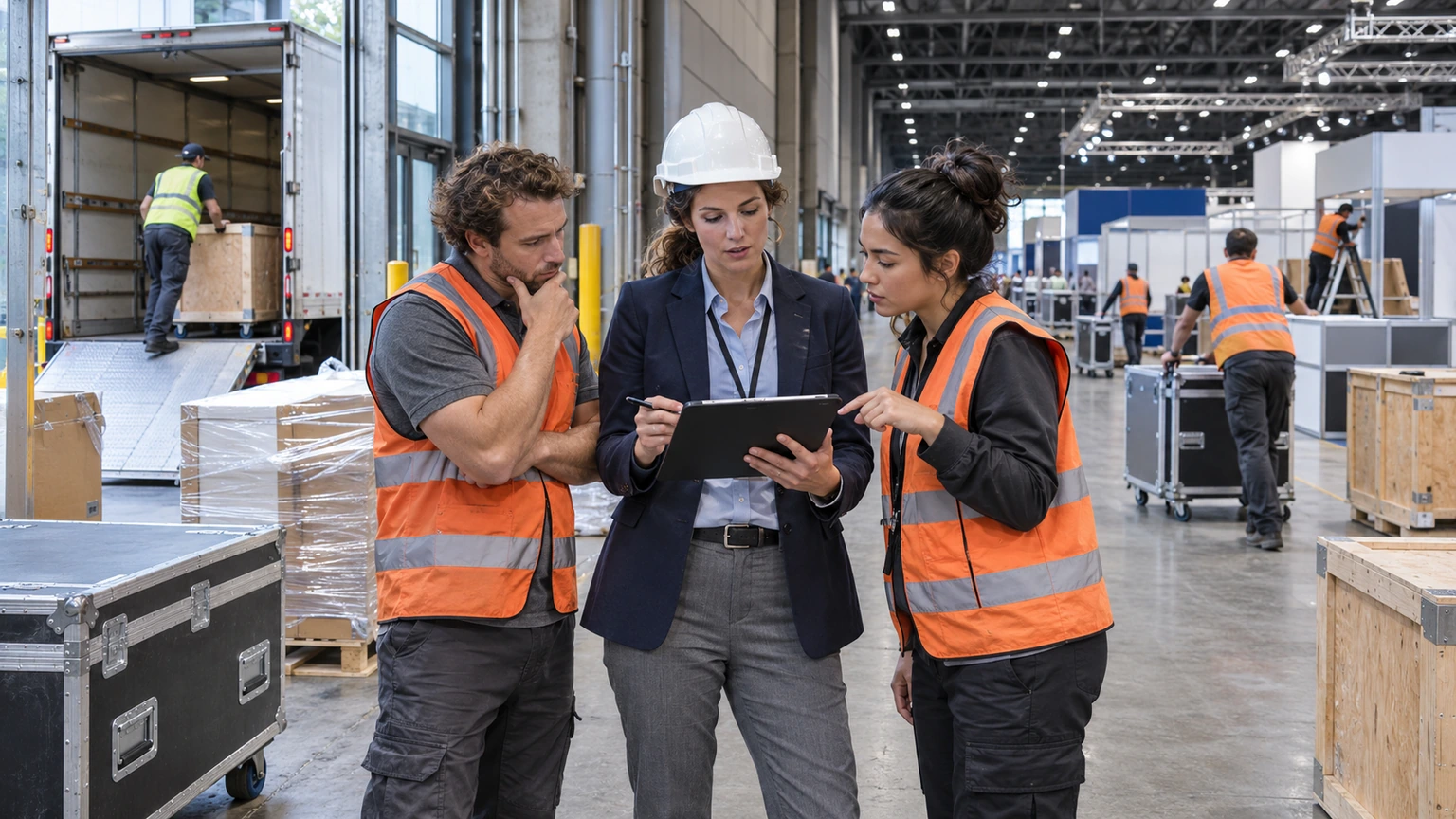
Large industry expos are operationally demanding by default.
They combine exhibitor logistics, contractor coordination, timetable pressure, venue rules, attendee movement, and high expectations from sponsors and partners. When the event serves a technical sector, the margin for confusion gets smaller.
A recent public signal is coverage around Yuanhong Environmental Protection participating in the SMM LZE 2027 Lead & Zinc Conference and Industry Expo in Shanghai. That is useful for event teams because it points to continued activity in sector-specific industrial exhibitions. It does not by itself tell us which tools any organiser uses, which workflows are automated, or which technology setup is best.
At a large expo, logistics problems rarely stay in one lane. A missed deadline in one workflow usually becomes stress somewhere else.
Why this matters for event operations
Heavy-industry and materials-focused expos tend to create dense operating conditions.
Organisers may be handling:
- large exhibitor lists with varied operational needs
- technical booth requirements
- contractor and supplier dependencies
- strict move-in and move-out windows
- conference and expo activity happening in parallel
- multiple stakeholder groups, including exhibitors, speakers, sponsors, venue teams, and service partners
- high volumes of deadline-driven communication
That makes expo logistics a data and coordination problem as much as a venue problem.
When information is scattered across email threads, spreadsheets, PDFs, and disconnected teams, the event becomes harder to control. Event technology can help, but only when it is applied to the real points of friction.
What we can say, and what we cannot
From the source signal, it is reasonable to say that industrial conferences and expos remain active formats, and that organiser workflows for these events are likely to be operationally complex.
It is also reasonable to say that event technology can support better coordination across exhibitors, schedules, communications, and on-site execution.
What we cannot say from this source alone is:
- which systems the named event uses
- how the organiser structures exhibitor operations internally
- which technology stack performs best for all industrial expos
- whether one workflow model suits every trade show in manufacturing, metals, or environmental sectors
- what measurable outcomes any named participant or organiser has achieved through software
That distinction matters. A public participation announcement is a useful signal of market activity, not a full operating blueprint.
Treat industry expo news as evidence of format relevance. The operations model still has to be designed event by event.
Start with the logistics bottlenecks, not the feature list
A common mistake is buying or configuring event tech around a broad promise of efficiency.
A better starting point is simpler: where does the event slow down, and who feels that delay first?
For large expos, the answer usually appears in a few familiar places:
- exhibitor onboarding and document collection
- manual deadline chasing
- confusion around setup requirements
- late changes to floor, sessions, or access details
- slow internal handoff between sales, operations, and on-site teams
- weak visibility into who has completed what
Once those pressure points are clear, technology decisions become more grounded.
Use one source of truth for exhibitor operations
Large expos become unstable when exhibitors receive instructions from too many places.
If key information sits partly in email, partly in attachments, partly in sales notes, and partly with individual account managers, errors become hard to avoid. Organisers should aim for one clear operational record for each exhibitor.
That record usually needs to cover:
- company details and main contacts
- stand type or participation package
- key deadlines and submission status
- service requests
- operational notes and exceptions
- messages sent and updates received
The goal is not sophistication for its own sake. The goal is to reduce repeated clarification and stop teams from working off different versions of the truth.
Separate marketing communication from operational communication
Expo teams often send a lot of messages. The problem is that not all messages do the same job.
Promotional updates, audience-building campaigns, and sponsor announcements should not be mixed with operational instructions that determine delivery. When teams combine them, important logistics get missed.
Operational communication should be easy to identify and easy to act on.
That usually means:
- clear subject structure
- deadline-led messaging
- links to the exact task required
- simple status language
- consistent ownership of follow-up
For large industry expos, this matters even more because many exhibitor contacts are balancing event prep with production, sales, travel, and compliance responsibilities.
Build deadlines around dependencies, not around calendar habit
Many expo timelines look orderly on paper but fail in practice because they are organised by tradition rather than by dependency.
A stronger model is to map what must happen before something else can happen. That sounds obvious, but it is often skipped.
For example, teams may need to sequence:
- exhibitor confirmation
- booth detail collection
- service ordering
- access planning
- final logistics instructions
- move-in readiness checks
If the timeline ignores those links, support volume rises near the event because exhibitors are asked to complete tasks before they have the information needed to do them properly.
Technology helps most here when it gives organisers a reliable view of incomplete tasks and approaching risk, not just a place to store forms.
Keep conference and expo schedules operationally connected
Industry events often blend exhibition activity with technical sessions, leadership talks, networking, and partner programming.
That creates a coordination issue. The conference agenda is not separate from expo logistics. It changes attendee flow, staffing pressure, sponsor timing, and exhibitor expectations.
Organisers should connect these moving parts early:
- opening hours and session peaks
- staffing plans for registration and help points
- sponsor activations tied to stage moments
- VIP or delegation movement
- traffic expectations around key presentations
- announcements that affect the expo floor
When the agenda lives in one workflow and exhibition delivery lives in another, teams often miss avoidable clashes.
Make on-site access and check-in practical
At large expos, check-in is not only about speed. It is also about role clarity.
Different audiences may need different treatment: exhibitors, contractors, speakers, attendees, sponsors, press, and VIP guests. If staff cannot quickly identify who someone is and what they should be able to do, queues and escalations follow.
A practical access setup should help teams answer a few questions quickly:
- Is this person expected on site?
- What role are they assigned?
- What area or activity are they linked to?
- Is anything missing before they proceed?
- Who handles exceptions?
The more industrial and logistics-heavy the event is, the more important those answers become.
Do not leave supplier coordination outside the operating system
One reason expo delivery becomes chaotic is that key suppliers are managed in separate channels until the final days.
Stand builders, freight contacts, venue services, AV teams, and temporary staff all affect delivery quality. If the organiser's main workflow does not account for these handoffs, internal visibility weakens fast.
This does not mean every supplier needs the same system access or process depth. It means the organiser needs a disciplined way to track what has been requested, confirmed, changed, and completed.
Even a simple status structure is better than relying on scattered updates.
Plan for exception handling before the event opens
Large expos rarely fail because the standard path was unclear. They fail because the exception path was ignored.
Typical exceptions include:
- late exhibitor substitutions
- missing documentation
- last-minute staffing changes
- badge corrections
- booth requirement changes
- speaker timing shifts
- access issues for contractors or guests
If teams have to invent the answer on site, the response will be slow and inconsistent.
Event technology is most useful here when it supports quick verification, visible notes, and clear assignment of who resolves what.
A practical rollout sequence for organisers
For teams reviewing their expo operations, a simple sequence usually works better than a large transformation project.
- List the highest-friction logistics tasks from the last event.
- Identify where information currently lives and where it breaks.
- Decide which workflows need one shared record.
- Separate audience marketing from operational messaging.
- Rebuild deadlines around dependencies and approvals.
- Define on-site roles, access paths, and exception handling.
- Test the process with internal teams before exhibitor launch.
This keeps the technology conversation tied to delivery reality.
Where teams should be careful
Not every expo problem is a software problem.
Organisers should be careful about:
- adding too many steps for exhibitors
- copying workflows from a different event format without adjustment
- treating data capture as the same thing as process control
- launching new systems without clear internal ownership
- assuming all exhibitor groups need the same level of guidance
- forgetting that on-site teams need simple, fast interfaces and clear escalation paths
Industrial expos often involve participants with very different operating maturity. The process has to be structured enough to control risk, but simple enough to use under time pressure.
What good looks like
A well-run large expo usually feels calmer than the workload behind it.
Exhibitors know what they need to do. Internal teams can see status without chasing multiple people. Operational messages are clear. Schedule changes reach the right audience quickly. Check-in staff can resolve common issues without guesswork. Suppliers and service partners are not managed as an afterthought.
That outcome is less about having the most advanced system and more about using technology to support clear operational design.
What this means for event teams
The public signal around SMM LZE 2027 and participation from companies such as Yuanhong Environmental Protection is a reminder that specialised industrial expos continue to matter.
For organisers, the useful takeaway is practical: when an expo combines technical audiences, exhibition delivery, and conference programming at scale, logistics must be treated as a connected workflow.
Technology can help streamline that work, but only when teams start with real coordination problems, clear ownership, and a simple operating model.
In other words, good expo tech is not just about digitising forms. It is about reducing operational ambiguity before it becomes on-site friction.